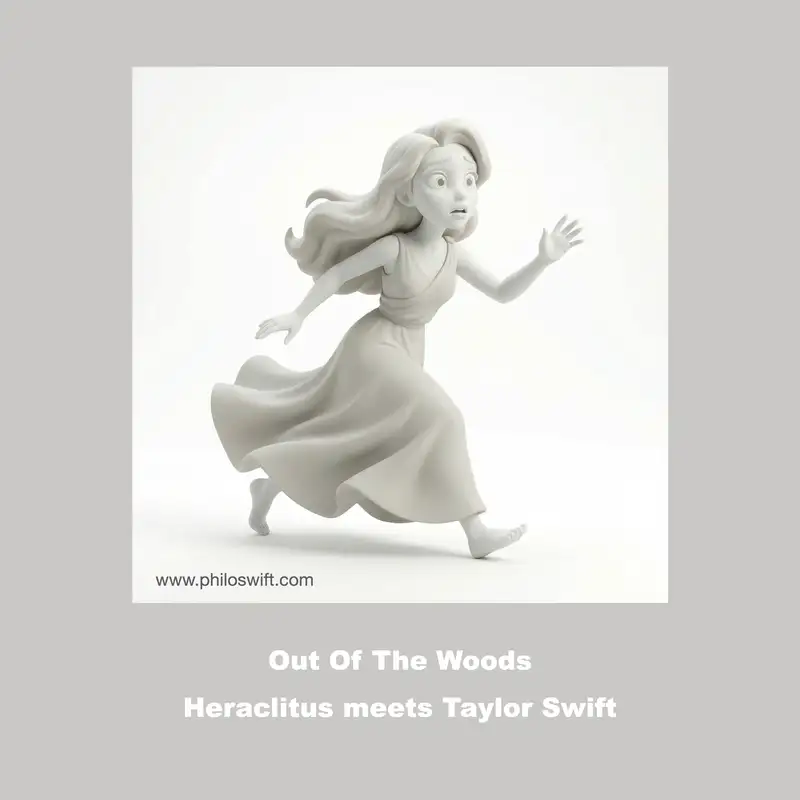
Taylor Swift : Out of the Woods - The Heraclitus Easter Egg
I want you to start by painting a very specific, um, somewhat bizarre mental image for me.
Okay, I'm ready.
So, put yourself in the back seat of a car. It's the middle of the night, and it is just sweltering hot.
Oh, the absolute worst kind of heat.
Right. And the air conditioning is totally broken. Rain is streaking down the windows, kind of distorting all the streetlights outside.
A very cinematic, sets a mood.
Exactly. But here's the catch. Sitting in that cramped, suffocating back seat is the biggest, most heavily scrutinized pop star in the world.
Okay.
And sitting right next to her, staring out the window, is a notoriously grumpy, difficult man who died, uh, roughly two and a half millennia ago.
That is quite the visual.
Oh, and just to make it complete, he is slightly covered in dried cow dung.
I mean, it is a profoundly absurd tableau, right? You have the ultimate symbol of this hyper-modern, hyper-visible celebrity trapped in a confined space with a man who deliberately retreated into the mountains to escape humanity.
Yeah, a guy who left behind nothing but these really cryptic fragments of thought.
Exactly. It sounds like a total fever dream.
It does. But this exact scenario is actually the foundational premise of the text we are doing a deep-dive into today.
Yes, it's such a fascinating source.
We're looking at this anonymous, incredibly subversive book titled Out of the Woods: Heraclitus Meets Taylor Swift.
Which is just a wild title to begin with.
Seriously. And it's written under a pseudonym, uh, Mouse Colored Cat.
Yeah.
Or in the original Taiwanese Mandarin publication,
Right, and the author remains a total mystery, but their agenda is entirely transparent. I mean, they're basically attempting an act of intellectual demolition.
Which brings us to the mission of this deep dive. For you, the listener, we are going to spend our time today entirely dismantling that artificial velvet-roped wall that society has built.
The one between the screaming pop stadium and the super quiet university library.
You got it. We are exploring a highly provocative proposition here. Can a three-and-a-half-minute mass-produced pop song function as a Trojan horse for ancient Greek metaphysics?
It's a massive question.
It really is. Do the seemingly trivial questions that keep you awake at 2:00 in the morning actually mirror the exact same existential terrors that haunted the greatest philosophers in human history?
To do this properly, though, I think we need to establish the ground rules of the text right away.
Oh, absolutely. The disclaimer.
Yeah, the author makes a very specific disclaimer in the opening pages. They say, "Look, this is not an explainer on Taylor Swift's biography."
Right.
"And it is not a dry, academic textbook on ancient philosophy either. We are not analyzing who a song is about, and we definitely aren't translating ancient Greek syntax."
Thank goodness for that.
Right. We are simply seating these two figures at the exact same table in the exact same room and waiting to see who spills their secrets first.
I love that setup. And the book opens with this really brilliant piece of literary framing.
Yes.
The author creates this, uh, apocryphal forward.
It's so well done.
It's a completely fabricated diary entry, written from the perspective of Taylor Swift, and it's timestamped at 2:00 AM.
Ugh, the witching hour. The text actually describes 2:00 AM as this temporal borderland, somewhere between noise and silence.
That's beautifully put.
It's that exact moment when the distractions of the day strip away, and you are just left entirely alone with the architecture of your own mind.
Yeah, and in this imagined confession, the pop star reflects on a lifetime spent trying to capture the ephemeral. She writes about the bizarre relativity of time.
Like how time stretches into infinity when you're just waiting for someone to call.
Exactly, or how it compresses into a single second when you're falling in love, and how it just stops completely dead, like freezing you in amber when your heart is broken.
Which is such a universal feeling.
It is. But she describes being constantly told by critics and the culture at large that her feelings are, quote-unquote, "Too much."
Right, they're too loud, too frequent, too intensely feminine.
Yeah, the prevailing narrative is always just that she merely writes breakup songs for teenage girls.
Which the author uses this fake diary entry to completely dismantle. They expose the sheer hypocrisy of that cultural critique.
Oh, big-time. We have this terrible habit of pathologizing the emotions of young women.
We really do. We treat the emotional volatility of a teenager as something trivial, like it's just something to be outgrown and discarded.
Right, like it's embarrassing or something.
But the text asks this piercing question. "Why do we pretend that adolescence isn't the exact moment when a human being encounters the world with the absolute violence of a summer storm?"
Wow. That is the pivotal realization in this opening section, isn't it?
Yeah.
The text has her realize that these overwhelming, supposedly teenage girl emotions are actually the raw, unrefined ore of philosophical inquiry.
Exactly. She isn't just asking trivial questions about a boy who didn't text back.
When she asks, you know, "Why does the memory of a scarf left in a drawer weigh more heavily than an entire decade?"
Yeah.
She is fundamentally probing the nature of material objects in memory.
Yes, and when she asks, "Are we defined by those who love us or by those who leave?" she is wrestling with the exact same existential dread regarding the gaze of the other that Jean-Paul Sartre built his entire career on.
I mean, the author even connects her lyrics to Plato's Allegory of the Cave.
Which blew my mind a little bit.
Right. Because when a pop song questions whether a romance was real or just a projection, it is literally debating illusion and reality.
Mm-hmm.
Her sleepless nights are mirroring the existential anxieties of Kierkegaard.
The dread, the repetition, the search for meaning in the aftermath of a collapsed relationship.These are not just girls' problems.
Not at all.
They are the foundational problems of human consciousness.
I wanna spend some time on the cultural divide here, because the book's preface anticipates the backlash.
Oh, they definitely know what's coming.
The author totally knows that serious people are going to smirk at this premise. They are gonna roll their eyes at the idea of placing a stadium pop star next to a foundational Greek philosopher.
So they bring in Pierre Bourdieu to explain that smirk.
Yes. Let's lean into Bourdieu. He's this French sociologist, and the author focuses heavily on his 1979 landmark book, Distinction.
It's a crucial piece of the puzzle. Bourdieu's entire thesis was about how taste and cultural preferences are not objective measures of quality or intellectual depth.
Right. It's not actually about what's good.
Not at all. Instead, taste functions as a weapon of social sorting. We use our cultural consumption to signal our class, our education, and our pedigree.
We basically just wanna distance ourselves from the masses.
That is the absolute crux of the author's argument. Society decides what is worthy of deep contemplation and what is relegated to mere entertainment based almost entirely on its circulation, not its inherent complexity.
High culture circulates with academic credentials, peer-reviewed journals, and expensive university tuition.
While low culture circulates via Spotify playlists, radio airplay, and viral videos.
Okay, let's pull the thread on how this social sorting actually works mechanically. I was thinking about this, and it's kind of like the VIP section at a highly exclusive nightclub.
Oh, I like that analogy.
Think about it. The velvet rope isn't there because the physical space inside the VIP section is inherently better. The air is then cleaner, right?
Right. And the drinks are poured from the exact same bottles as the main bar.
Exactly. The velvet rope exists purely to provide visual proof that the people inside are separate from and elevated above the general admission crowd.
And in the intellectual world, academia acts as the bouncer.
Yes. The velvet rope is constructed out of dense, impenetrable Latinate jargon, paywalled research papers, and a culture that demands a specific detached tone.
So, if an idea is wrapped in a 500-page treatise that requires a master's degree just to decode, it remains safely inside the VIP section. It functions perfectly as a status signal.
But what happens when a profoundly complex philosophical concept about the nature of time and memory is translated into a three-minute perfectly engineered pop song?
A song that 70,000 people sing along to in a stadium?
It bypasses the bouncers completely. It democratizes the knowledge.
Which is exactly why the traditional gatekeepers are terrified of it, because if everyone understands the concept, it loses its utility as a marker of elite status.
So my question for you is, is traditional philosophy just guarding its VIP section with dense academic jargon 'cause it's terrified of mingling with general admission pop fans?
I think the text makes a razor-sharp observation here that basically says, yes, the smirk is just a defense mechanism.
A way to protect their territory.
Exactly. Pop culture is treated with suspicion by the intellectual elite, not because it lacks depth, but because it spreads too widely. If the masses can access the catharsis and the existential questioning without paying the toll of academic rigor, the gatekeepers lose their authority.
Which is why the author writes directly to the fans in this section. There is this one line that serves as the thesis statement for this entire deep dive.
Oh, I know the line you're talking about.
Don't let anyone tell you that your intensity is weakness, your tears are ink, your doubts are philosophy.
It gives me chills. It's a powerful reclamation of the emotional landscape. The text insists that translating a dense philosopher into a catchy verse is not a betrayal.
It's not dumbing down the material at all.
No, it is actual fidelity to the core idea. The book points out a wonderful structural parallel here. Pop music relies heavily on Easter eggs.
You know, hidden references, recurring motifs, secret messages meant for the most dedicated listeners to decipher over time.
And philosophy has the exact same mechanic. Academics just dress it up in a tweed jacket and call it subtext or intertextuality.
That is so true. Digging through a pop album at 2:00 AM to find the connective tissue between a lyric written a decade ago and a lyric written today is the exact same cognitive exercise as a scholar tracing the evolution of a concept through Nietzsche's journals.
The author is basically giving the listener permission to take their own cultural consumption seriously.
So to understand how a stadium anthem manages to sneak past those academic bouncers, we first need to meet the man who essentially invented the concept of a reality built entirely on anxiety and shifting ground.
The architect of change himself.
Yes. Let's look at Heraclitus of Ephesus. We really need to understand the world he was operating in. He was born around 535 BCE in Ephesus.
Which was a massive, wealthy, bustling port city in ancient Ionia, right on the coast of modern-day Turkey.
Right. This wasn't some sleepy, quiet village. It was a chaotic intersection of trade, cultures, and immense political tension. And Heraclitus was not just a common citizen.
Far from it. He was born into an aristocratic family of the highest order.
He was reportedly in line to inherit the title of Basileus, which carried immense political and religious authority. It was essentially an honorary kingship.
But he didn't take it. The historical record tells us he abdicated the position and just passed it to his younger brother.
The book describes this act with the quiet finality of someone closing a door and never looking back. He walked away from immense privilege, power, and societal influence.
Which begs the question, why? Why? What drives a man to abandon the absolute pinnacle of ancient society?
Well, according to the text, it was an utter, unrelenting disgust with the masses and the superficiality of political life.
He looked at the wealthy, bustling city of Ephesus and just saw a population of sleepwalkers.
That's a great way to put it. He believed that the vast majority of human beings live their lives in a state of delusion, chasing wealth, status, and momentary pleasures without ever questioning the underlying nature of reality.
He basically didn't wanna rule over people he fundamentally did not respect, so he chose to be a thinker instead of a ruler.
And his thinking resulted in a philosophy that we are literally still trying to decode 25 centuries later. He left behind no comprehensive books, only what they call The Smoke, a collection of aphorisms and highly cryptic fragments.
But the absolute bedrock of his worldview can be distilled into two Greek words, panta rhei.
Everything flows.
Everything flows. It is the concept that nothing in the universe remains static. The most famous distillation of this idea, the one that has completely permeated global consciousness, is his assertion that you cannot step into the river twice.
Now, on the surface level, that seems totally obvious. You step into a river, the current pulls the water downstream. And if you step in again, obviously, it's new water.
But Heraclitus is pointing at something much more terrifying than just moving water.
He's pointing at the nature of existence itself, Bren.
Exactly. Existence is not a state. It is an activity. The water has shifted, yes, but more importantly, you have shifted.
The person who stepped into the river this morning is fundamentally, structurally, and psychologically not the exact same person stepping into the river tonight.
Your cells have regenerated or died. Your mood has altered. A single conversation you had at lunch has irrevocably changed your perspective on the world. You are in a state of constant, unrelenting flux.
So, let's apply this to a deeply modern dilemma. Think about the overarching goal of so much of modern life. We are just obsessed with the pursuit of stability.
Oh, absolutely.
We wanna lock down a stable career trajectory. We wanna find a partner, get married, and create a stable, unchanging relationship where we feel completely predictable and safe.
We build houses out of stone and sign 30-year mortgages just to manufacture a feeling of permanence.
Right. So, if Heraclitus says we can't step in the same river twice, does that mean our modern obsession with finding stability in a career or a relationship is mathematically impossible, according to him? Are we just mistaking the shoreline for the current?
According to Heraclitus, absolutely.
Yeah.
Seeking absolute permanence is not just a comforting illusion, it's a fundamental misunderstanding of the cosmos.
Wow.
If you try to freeze a relationship, demanding that your partner remain the exact same person they were the day you met, you are going to destroy the relationship. Change is not a glitch in the system.
It's not an accident that happens to reality when things go wrong.
No, change is the architecture of reality. However, the text points out a crucial nuance that is often lost in popular understandings of Heraclitus. He did not believe that this constant flux meant the universe was just random, senseless chaos.
Right. There is a method to the madness. It's not just purely nihilistic entropy.
He believed that behind all this relentless movement lies a principle he called the logos.
And the word logos is notoriously difficult to translate, right?
Very difficult. It can mean word, reason, proportion, or structure. For Heraclitus, the logos is a hidden, underlying tension that actually binds opposites together to create coherence.
He uses the metaphor of a bow or a lyre. Think about a bow. A bow only functions, it only has power because the wood is pulling one way and the string is pulling the exact opposite way.
Precisely. If you remove the tension, if you let the string go slack to achieve peace, the bow ceases to be a bow. It's just a useless piece of wood.
Day requires night to have meaning. Satiety requires hunger. Harmony isn't the absence of conflict. True harmony is conflict finding its perfect dynamic balance.
He famously wrote, "Strife is the father of all things."
Which is funny, because the author of the book, Riley, notes that Heraclitus figured out that strife drives engagement a couple of millennia before social media algorithms started monetizing our outrage.
That's a very sharp observation.
But Heraclitus' ultimate metaphor for the cosmos isn't an algorithm. It's fire. He didn't view the universe as a machine made of static parts. He viewed it as an ever-living fire.
But not a wild, destructive forest fire. A measured flame. The text states, "The world burns in proportion."
And when the author applies this Heraclitan fire to human connection, it completely shatters the modern paradigm of romance. The text argues a relationship is not a contract. It is combustion.
As long as the relationship burns, meaning as long as there's an exchange of energy, tension, adaptation, and friction, it exists.
And when the fire finally goes out, when the relationship ends, it hasn't vanished into nothingness. It has simply transformed, according to the logos.
The text puts it so beautifully. "Ash is still wood. Memory is still love. The energy just changes states."
It is an incredibly poetic and resilient way to view heartbreak. But the book does not let Heraclitus off the hook. It highlights a deeply tragic, honestly almost comical irony about it as well.
Oh, this part is wild.
Here's a man who possessed a more profound understanding of change and adaptation than perhaps anyone in human history, yet personally, he was remarkably rigid.
He was infamously stubborn. As he grew older, his misanthropy really deepened. He eventually withdrew from public life entirely, leaving the city to wander the mountains, eating grass and herbs.
Just totally disconnected.
Yes. He despised the opinions of crowds, and he held a particular virulent distrust for physicians.
Which became a really fatal problem when he fell severely ill. He developed dropsy, which we now know as edema, a condition where the body accumulates excess fluid, causing severe swelling.
And because he refused standard medical advice, believing his own intellect was far superior to any trained doctor, he attempted a DIY medical procedure based on his own philosophical theories.
This is where it gets crazy.
He believed his body was suffering from an excess of the wet element, and he needed to introduce heat to dry it out.
And his brilliant solution for introducing that heat was to cover his entire body in cow dung.
Yes.
He was hoping the warmth of the manure would somehow evaporate the moisture trapped inside him.
The historical accounts of his death are somewhat varied, but the most prominent narrative is that the manure dried and hardened around him like a shell, trapping him.
Oh, my God.
And he either died from the illness from the heat, or in one particularly grim account, was left immobilized and devoured by wild dogs. He died around 475 BCE, alone, suffocating in a shell of his own making.
The author really leans into the absolute irony of this.
Yeah.
The Philosopher of Flux completely refused to adapt his own behavior. He understood the mechanics of the fire, but as the text notes, understanding the fire does not prevent you from getting burned.
It's a tragic paradox.
He earned the nickname The Obscure 'cause his writing was deliberately resistant to easy interpretation. And now, 25 centuries later, we're gonna take his obscure, dense fragments about a reality built on relentless flux and map them onto a synth-pop stadium anthem.
It's quite the pivot.
Let's look at the anatomy of the song at the center of this book, Out of the Woods, the sixth track from the album 1989.
To bridge the gap between ancient emphasis and modern pop production, the author introduces a brilliant satirical device. They create a completely fictional, aggressively pedantic academic named Professor Malcom Merriwell.
Professor Merriwell is the ultimate caricature of tenured academia. I mean, he approaches this three-and-a-half-minute pop song with the grave seriousness of an archeologist deciphering the Rosetta Stone.
Merriwell fixates on the core structural feature of Out of the Woods, which is the obsessive relentless repetition of a single question in the chorus.
The lyrics ask, "Are we out of the woods yet?" Followed by, "Are we in the clear yet?" A staggering 36 times throughout the track.
36 times. If you were just passively listening to the radio, that repetition might just register as a catchy, maybe overly aggressive pop hook designed to get stuck in your head.
Right.
But Professor Merriwell argues that this repetition is not a structural flaw, nor is it a lack of lyrical vocabulary. He diagnoses the chorus as a manifestation of anxiety-inducing stroboscopic resonance, or ASR.
I just love that phrase, anxiety-inducing stroboscopic resonance. So Merriwell claims the song isn't just about a relationship, it is a functioning sonic model of panta rhei.
Exactly, it is an auditory simulation of constant flow. He describes the chorus as a controlled flow loop, calibrated at what he absurdly terms 10,000 existential hertz.
Okay, I wanna break down the mechanics of Merriwell's theory, because beneath all the faux academic jargon, the author is making a profound psychological point here. Merriwell introduces the Heraclitian iteration principle, or HIP.
HIP.
Yeah, the theory posits that when you repeat a question while you are immersed in a state of emotional flux, the meaning of that question physically cannot remain static. Because you are moving down the river, the words undergo a semantic drift.
And Merriwell mathematically calculates this drift at exactly 10,000 microns per repetition.
A micron being a unit of length equal to one-millionth of a meter. It's entirely microscopic.
But Merriwell's joke is that the emotional displacement is cumulative. You never ask the exact same question twice, because the person asking the question the second time carries the memory and the failure of the first time they asked it.
So if you multiply his imaginary 10,000 microns of semantic drift by the 36 refrains in the song, you get a cumulative displacement of 360,000 microns.
And if you convert 360,000 microns, you get exactly 36 centimeters.
And Merriwell, adjusting his fictional glasses, smugly points out that 36 happens to be Taylor Swift's exact age at the time of this book's publication in 2026. He claims to have spent thousands of hours trying to prove this is not a coincidence.
It's a hilarious send-up of over-analysis. But the text doesn't let Merriwell have the final word here. It brilliantly undercuts his academic posturing by introducing his graduate assistant, a man named Gaston Blunder.
Gaston is exactly the pragmatic grounding wire this crazy theory needs. He looks at Merriwell's complex micron equations and basically translates them into brutal, everyday human language.
Gaston points out that Heraclitus says you can't step into the same river twice. Well, the pop star is demonstrating that you can't ask the same question twice.
Right. By the time you reach the 36th repetition of, "Are we out of the woods yet?"
Hmm.
Huh. You have fundamentally altered the nature of the inquiry. You are no longer just checking a map or asking for directions out of a literal forest.
The first time the chorus hits, the question is born of genuine hope. Maybe the worst of the relationship's turbulence is over.
But by the tenth repetition, doubt has really crept in.
By the 20th, it's sheer desperation. By the 30th, it is a frantic negotiation with reality.
Until finally, as the synths are just crashing around the vocals, you reach this terrifying psychological breaking point where you realize the question itself is the relationship. The anxiety isn't a temporary glitch in the system that will eventually be resolved. The anxiety is the operating... system.
Yes, and Gaston grounds this high-minded philosophy in socioeconomic reality. He says he understands Heraclitean flux perfectly, and his landlord understands it, too.
Ah, Gaston's great quote.
Gaston quips, "'Panta rhei,' my ass, 'panta pei.' Now, that I believe."
That's so real.
The ground beneath Gaston is always shifting financially. His rent increases, inflation rises, his stability erodes, just as the ground shifts emotionally within the architecture of the song.
To really hammer home how repetition functions, the author includes a multiple-choice quiz for the reader. The premise is simply, why did she choose to repeat the phrase exactly 36 times?
The options are fantastic.
Option A is the dismissive view, she just forgot she already asked it. Merriwell rules this out as neurologically naive. Option B is Merriwell's own 36-cm semantic drift theory.
Then option C is where the brutal cynicism of the music industry enters. It suggests the repetition is purely financial. Pop super-producer Max Martin allegedly charges $10,000 per structural loop, and 36 repetitions perfectly finances a modest Heraclitean yacht.
A yacht that, true to form, never docks in the same harbor twice.
Exactly. Gaston naturally gravitates toward the financial explanation, but option D is the philosophical payload of the entire section.
Option D suggests that obsessive repetition is the mark of a mind that has encountered a truth too large to state only once. Let's really pull the thread on that idea. Have you ever played that psychological game where you say a completely normal word out loud over and over again?
Oh, yeah, semantic satiation?
Right. Take the word spoon, spoon, spoon. If you say it three times, you picture a piece of silverware, but if you say it 30 or 40 times in rapid succession, something weird happens in your brain.
The word completely detaches from the physical object.
It loses its symbolic meaning. It stops being a tool for eating soup and just becomes a bizarre alien sequence of sounds.
Spoon.
It's a psychological mechanism where continuous repetition causes the neural firing in the brain to temporarily fatigue. It basically strips away the learned meaning of a word and leaves only the raw auditory sensory data.
Yes, and that is precisely what the repetition in Out of the Woods is doing, but on a massive emotional scale. It is applying semantic satiation to the very concept of safety.
That's a fascinating way to look at it. By asking, "Are we out of the woods yet?" 36 times over a relentless driving beat, the song systematically strips away the illusion that the woods are a physical place you can ever actually leave. The repetition murders the concept of a final stable destination.
The listener's forced to inhabit the perpetual present of the panic.
It performs the absence of an answer. If you look at the narrative details embedded in the verses of the song, the sudden emergency of hitting the brakes too soon, the physical trauma of 20 stitches in a hospital room, the image of necklaces hanging from necks, these aren't just isolated catastrophes that ruin an otherwise stable timeline.
No, they are proof of concept.
The world works exactly as Heraclitus said it does, by burning, by crashing, by constantly reshaping itself through strife.
So we have this compelling, intricately layered defense of the song's depth, but the author is acutely aware that the traditional gatekeepers of intellect are not going to surrender their VIP section simply because we theorized about semantic satiation.
They're gonna put up a fight.
Absolutely. This brings us to a pivotal confrontation in the book, a section titled The Dinner Party Clash.
The author stages a theoretical dialogue between two archetypes sitting across from each other at a formal dinner table, the snob and the Swiftie.
It is the perfect concentrated encapsulation of the cultural divide we discussed earlier regarding Bordeaux. Now, I want to take the side of the snob for a moment to really give this argument some teeth, because the snob is articulating what a large portion of the public actually believes.
Oh, for sure. Go for it.
The snob goes on the attack immediately. He listens to Out of the Woods and dismisses it entirely. He calls it three minutes and 40 seconds of manufactured anxiety on repeat. His core critique is that the song is emotionally loud, structurally thin, and philosophically modest.
Ouch.
He argues that when Heraclitus wrote, he articulated a true logos, a rational underlying principle of the cosmos. When Taylor Swift writes a chorus, she's merely articulating a highly effective marketing strategy designed to activate the pleasure centers of a teenage brain.
It's the classic critique.
The snob asks, "Isn't this just a four-chord progression designed to sell out football stadiums? Why are we projecting ancient metaphysics onto a product of a modern entertainment industrial complex?"
It is a formidable, deeply entrenched critique, but the Swiftie's defense is just a master class in dismantling double standards.
How does the Swiftie counter?
Well, the Swiftie points out the inherent hypocrisy in how society judges the exact same structural mechanic depending on who employs it. When Heraclitus circles the same idea over and over in a fragment, academics stroke their chins and call it profundity, or meditative depth.
Right.
But when a pop star circles the same idea in a chorus, critics roll their eyes and call it overexposure, or lazy writing.
The Swiftie demands that the snob actually listen to the architecture of the pop song. The Swiftie argues that a logos does not have to be written in a dusty book. A logos is simply an organizing structure that exists beneath apparent chaos.
And if you analyze the production of the song, it is not structurally thin at all. The layering of the synthesizers builds incrementally. The rhythmic pressure accumulates with mathematical precision.
The background vocals are isolated and then stacked.
When the chorus returns for the final time, it is fundamentally altered by the sonic and lyrical context of the bridge that preceded it. That is structure. That is a modern logos. And as the Swiftie delivers the killing blow to the argument...It just happens to chart.
Oh, that is so good. So the snob, feeling his intellectual authority slipping, falls back on the ultimate defense of traditional philosophy. He claims that true philosophical inquiry requires emotional distance.
Of course he does.
He says it requires reflection, objectivity, and a detachment from the raw feeling. He accuses the swifty of mistaking romanticized agitation for actual thought. The snob believes that to understand the storm, you must stand safely on the shore, observing it through a telescope.
And the swifty deconstructs that arrogant assumption, using Heraclitus's own foundational beliefs against the snob.
Wait, really?
The swifty reminds the table that Heraclitus did not believe in a calm, detached universe. He believed that strife, tension, and combustion were the very engines of reality.
Oh, right. The bow and the lyre.
Therefore, an emotionally detached, completely objective worldview is actually a false representation of existence. If the ground beneath your feet is constantly shifting, if the river is rushing violently forward, true clarity shouldn't look calm and composed.
True clarity should look like instability. It should sound like breathlessness.
Exactly. The snob demands that knowledge look a certain way. He wants it neatly bound, properly sided, and drained of all messy human fluids. The swifty shatters that requirement with a beautiful defining metaphor.
What is it?
The river doesn't look unstable because it's shallow. It moves because it's alive.
Wow. The snob is completely mistaking the intense kinetic vitality of the pop song for shallowness.
Yeah.
He assumes that because the water is thrashing, it must not be deep. But the movement itself is the proof of the depth.
It's a complete victory for the swifty at the dinner party. But theoretical debates only go so far, you know?
Right. What would actually happen if we forced the 21st century pop star and the ancient misanthrope to interact in physical space?
Which leads us to the narrative centerpiece of the book, the taxi ride.
The author constructs this incredibly detailed hypothetical transcript of an Uber ride between Taylor Swift and Heraclitus. It is a 4.2 kilometer journey through a sleeping city.
The atmosphere the author builds is incredibly cinematic. You can basically feel the humidity in the car.
The air conditioning is broken. Heraclitus is sitting in the back, tracing the paths of the raindrops on the window, watching the water merge and separate, as if the droplets are actively revealing the microscopic secrets of the cosmos.
The dialogue begins with just a simple attempt at small talk. Taylor asks, "Where are you coming from?"
Heraclitus replies, "From the river."
She says, "Oh." And then he drops the ultimate Hera-cliting hammer. "You never get into the same Uber twice."
Taylor doesn't miss a beat. She quips back, "Well, that depends on the driver." But Heraclitus, ever the pedant, insists, "Even the driver changes."
It's a fantastic, slightly surreal setup. As the ride continues, the conversation shifts to their respective vocations. Taylor mentions that she writes songs, primarily about relationships, breakups, and memory.
And Heraclitus responds by reiterating his core tenet. He tells her, "A relationship is a fire." When she asks him to elaborate, he explains the mechanics of combustion. He says that everything eventually becomes fire.
Breakups are not endings. They are simply intense transformations.
The emotional energy doesn't die when the couple separates, it just radically changes form. And Taylor delivers this perfect deadpan response. "I call them albums."
It's a very funny line, but it's masking a profound truth about the alchemy of art. She is taking the raw, destructive material of the fire, the grief, the ash, the fragmented memories, and she is intentionally transforming it into a tangible, structured product.
During a strange cosmic interlude while they are stopped at a red light, the conversation turns to the nature of crowds. Heraclitus, who famously despised humanity and withdrew into isolation because he believed people were oblivious, says that most men are fundamentally asleep.
They walk through life totally unconscious of the forces shaping them.
But Taylor pushes back, bringing up her fans. She describes what it's like to stand in front of 70,000 people who are all singing the exact same word simultaneously.
Heraclitus considers this and says, "They dream together."
That is beautiful.
He acknowledges that in that specific moment of mass catharsis, there is a hidden harmony. The individual egos temporarily dissolve into a shared emotional experience, a harmony that Taylor notes she deliberately engineers into the structure of her choruses.
But the tension in the car spikes when they discuss how the public actually consumes her art. Taylor expresses frustration that the public discourse surrounding her music is so relentlessly focused on the superficial details. People want to know which specific ex-boyfriend a song is about. They want the gossip.
Heraclitus observes, "They're listening to the names." He tells her that the public is entirely missing the point of the work. By obsessing over the specific biographical names, they are blinding themselves to the universal logos that she is actually articulating.
He insists that the lotos, the hidden structure of human grief, joy, and anxiety, is embedded in everything, and it is glaringly present in a well-crafted pop song.
Following the transcript of the ride, the author includes a letter from Heraclitus addressed to Taylor. This letter expands on his observation of her work. He writes to her, saying he has heard her repeat that desperate question, "Are we out of the woods?" over and over again.
He finds the question deeply touching, almost pitiful, because it reveals a universal human vulnerability. We all harbor this desperate, irrational hope that there will eventually come... a moment when things finally stop changing.
We wanna reach a clearing where the threats disappear, where the relationship is forever secure, and where we can finally just rest.
But then he delivers the brutal, unvarnished news from antiquity. He writes, "The forest changes as you walk through it. The person you love is mutating every single day. You are changing. Even the specific nature of the fear you feel in the dark is changing."
He reveals the harsh truth at the core of her iconic chorus. He says she is asking the exact right question. It's just that the answer she is looking for doesn't exist. "You never truly leave the woods," he writes. "You only learn to walk through the flames."
"You never leave the woods. You just adapt to the burning." That stark realization brings us to the end of the Uber ride, which concludes with a beautiful, almost heartbreaking philosophical irony.
Ah, the ending is so poignant.
The car pulls up to the curb. The driver puts the car in park and announces, "We're here." The physical destination has been reached, but Heraclitus doesn't move. He simply replies, "This journey no longer exists."
Because the flow of time has already consumed it. The very moment of arrival is instantly relegated to the past.
I want to pause here and unpack this, because it has profound implications for how we process our own lives. Think about how we, you, me, the listener, how we interact with our own memories.
We tend to treat our past relationships, our childhood traumas, or our greatest triumphs as fixed, stable destinations on a map.
Right. We believe that when we reminisce, we are simply driving back to that exact spot and looking at the event exactly as it happened.
But neurobiology and Heraclitus both tell us that is a lie. Every single time you pull up a memory, the physical act of remembering it actually rewrites the neural pathway in your brain.
Your current ever-changing self alters the data. If you look back at a past heartbreak today, you might view it with the wisdom of distance. If you look at it tomorrow after a really bad day, you might view it with intense bitterness.
The journey you took to get to that original moment no longer exists in its original form. You are never, ever returning to the exact same place. The memory itself is subject to panta rhei. It is in constant flux.
It is a deeply unsettling, yet strangely liberating observation. Everything burns. Everything changes. Which makes the final massive pivot in this book so fascinating, because the author doesn't end the book dwelling on ancient philosophy or pop music.
No, they pivot sharply to deliver a very urgent, highly technical, and deeply modern warning.
Yes, we arrive at the afterword. Here, the book reveals its true colors. It is not just a clever literary mashup of a singer and a philosopher. It is actually a radical manifesto against the current trajectory of technology and human cognition.
The afterword is titled Antidote to Algorithmic Inbreeding.
The anonymous author, mouse-colored cat, finally steps slightly out from behind the curtain to directly address the looming shadow of large language models and generative artificial intelligence. They introduce a concept they call the paradox of infinite generation.
To understand this paradox, the author asks us to look back at the digital revolution of the 1980s and '90s. The great promise of early digital technology like CDs and digital image files was the concept of zero generation loss.
If you copied a song on a cassette tape, the copy was slightly worse than the original. If you photocopied a document, the text got blurrier. But digital files promised infinite fidelity.
You could copy a file a million times, and the millionth copy would be a pristine, mathematically perfect replica of the original. The signal never degraded.
But the author warns that today, with the explosion of generative AI, the threat landscape has entirely inverted. We are no longer facing the degradation of the audio signal or the pixel resolution. We are facing the degradation of meaning itself.
As the text states, "The more we generate, the less we create."
The author warns of a terrifying, very real phenomenon in machine learning called autophagy.
Autophagy is originally a biological term. It translates roughly to self-eating. It's what happens when a starving body begins to consume its own tissue to survive.
And in the digital realm, the author is describing a catastrophic feedback loop. Let's break down the mechanics of how an LLM actually works. An AI doesn't think.
No, it is a highly advanced statistical prediction engine.
It looks at a prompt and calculates the mathematical probability of what the next most likely word should be based on the vast ocean of human text it was originally trained on. But what happens now when the internet is flooding with AI-generated text? The AI models are increasingly scraping the web and training on data that was generated by previous AI models.
It's algorithmic inbreeding. It's the digital equivalent of the Habsburg Jaw. The models are devouring their own outputs.
When an algorithm trains on synthetic data, something mathematically devastating happens, model collapse. The AI systematically lops off the long tail of this statistical distribution curve.
And the long tail is where human weirdness lives. It's where eccentricity, bizarre metaphors, slang, and profound unexpected leaps of logic reside. It's the statistical outliers.
The AI favors the most probable average connections. With every generation of autophagy, the probability curve flattens. Thought becomes smoother. It becomes safer. And most chillingly, it becomes painfully aggressively averaged.
The machine produces a frictionless conformity.
To combat this terrifying slide into cognitive averageness, the author proposes a philosophy of resistance they call capacitivism, and they reveal that this entire book, the pairing of Heraclitus and Taylor Swift, is an active exercise in capacitivism.
The goal is to deliberately, forcefully break the algorithmic loop.
How do you break it? By introducing friction. By forcing connections that a statistical machine would never logically anticipate.
A machine relies on established patterns. It categorizes the ancient Greek philosopher in one database and the modern pop star in a completely different database. It would never calculate a high probability of joining them together.
The author calls this act intellectual vandalism.It's a purposeful overloading of the digital system. And they note that Out of the Woods is just one part of a larger collection of these vandalistic acts.
They list other pairings they have engineered, like applying the ruthless, calculating political philosophy of Niccolo Machiavelli to the getaway driver narrative of the song Getaway Car.
Or using the French philosopher René Girard's complex theory of mimetic desire, the idea that we only want things because we see other people wanting them, to deeply unpack the high school jealousy of You Belong With Me.
They are creating these absurd, brilliant, highly irregular images. The text describes it as putting Deleuze in lipstick or placing Wittgenstein in a slam door.
AI is unparalleled at organizing existing information into neat, predictable patterns. But the conceptual leap, the strange, messy, poetic pairing of an ancient theory of flux with a 21st-century breakup anthem, that requires the friction of a human mind.
As the author boldly states, "AI can organize, but only humans can dare."
If you think about the algorithms that dictate our lives as a giant, perfectly smooth sandbox, where all the tech companies have meticulously sanded down all the sharp edges of human thought to make everything safe, predictable, and easily digestible for advertisers...
Then this book and the philosophy of capacitivism is essentially acting like a handful of crushed glass thrown violently into that sandbox.
It's designed to wake us up. It is designed to make us feel the sharp, dangerous edges of ideas again before the machine smoothes them away forever.
That is precisely the author's intent. The citizen of tomorrow cannot afford to be someone who just passively consumes the endless smoothed-out flow of AI-generated information.
True sovereignty in the 21st century, what the author terms being a data sovereign, does not lie in just hoarding facts or memorizing data points. The machine will always be better at that than you. True sovereignty lies entirely in your ability to disturb the logic of the system.
Your power lies in your ability to misbehave creatively. I absolutely love that phrasing. Only humans can misbehave creatively.
The author signs off the afterword by claiming that the cat has taken the color of the mouse and successfully entered the machine.
It is a profound, demanding call to arms for the listener's own intellectual life. The text is challenging you to look for the subtext everywhere.
It is challenging you to make the unexpected weird connections in your own life, and to fiercely refuse the perfectly smoothed-out average answers that the algorithms are desperately trying to feed you.
So let's pull back and look at the sheer scope of the journey we've been on today.
We started by dissecting a fake 2:00 AM diary entry that completely reframed the cultural dismissal of teenage emotion, elevating it to the level of pure philosophical inquiry.
We traveled back 25 centuries to meet Heraclitus, an ancient aristocrat who understood that the universe is a constant measured fire, but who stubbornly suffocated in a shell of cow dung because he refused to adapt to his own reality.
We watched a completely fictional academic mathematically calculate the semantic drift of a pop chorus, proving that 36 repetitions of a phrase systematically destroys the concept of safety.
We sat at a tense dinner party and watched a Swiftie logically dismantle the arrogant assumptions of an intellectual snob, proving that a pop song's structure is a modern logos.
We rode in the back of a sweltering Uber, where we learned that breakups are just thermodynamic transformations, and that the journey we take to our memories fundamentally ceases to exist the moment we arrive.
And finally, we ended with a radical rebel manifesto, using all of this as a weapon against the terrifying, self-devouring averageness of artificial intelligence.
It is a breathtaking synthesis of seemingly incompatible ideas. The author takes the blinding lights of the stadium and the dusty silence of the library and forces them to recognize their shared DNA. They are both built on the exact same foundational, terrifying human anxieties.
And that ultimate realization brings us right back to you, the listener. The author's final point isn't just an abstract critique of technology. It is a direct challenge to how you operate in the world.
You aren't just meant to learn things passively. You aren't meant to just sit in the river and let the current drag you along.
You were meant to be the friction. You were meant to take the knowledge you acquire, smash it against something unexpected, and misbehave creatively with the pieces.
Because if you just accept the smooth, highly probable average outputs that society and technology offer you, you are essentially asleep, exactly as Heraclitus warned. You have to force yourself to stay awake to the flux.
Which leaves us with one final, deeply provocative thought to take away from all of this, something to let burn in your mind as you go about the rest of your day.
Heraclitus told us that you can never step into the same river twice. The water changes relentlessly, and more importantly, you change.
If we accept that as fundamental truth, then the person you were an hour ago at the start of this deep dive is fundamentally, biologically, and psychologically not the exact same person you are right now at the end of it.
Your cells have shifted. Your thoughts have drifted by thousands of microns. Your internal river has irrevocably moved forward.
So amidst all that relentless, unending, terrifying change, what is a logos?
What is that hidden structure, that measured fire that is holding your identity together at this exact moment? Are you out of the woods yet? Or are you just finally learning how to walk through the flames?