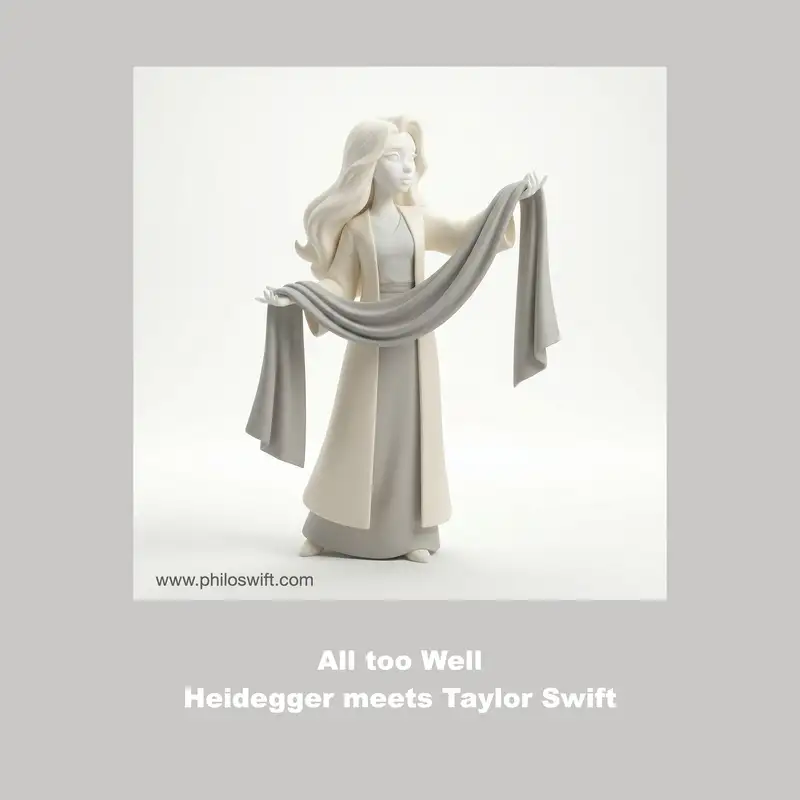
Taylor Swift : All too Well - The Heidegger Easter Egg
I want you to take a second and, uh, just picture a drawer in your house.
Oh, I think everyone has one of those.
Right, exactly. Like, maybe it's the bottom drawer of your heavy wooden
Mm-hmm.
or you know that one mismatched cardboard box you keep shoved way in the back of your closet.
Yeah, behind all the winter coats you never wear.
Exactly, behind the coats. Now inside that drawer, there is an object and you know exactly the one I'm talking about.
Oh, absolutely.
Maybe it's a faded, like, torn movie ticket from a Tuesday night five years ago, or maybe it's a worn out, slightly itchy sweater that doesn't even fit you anymore.
Or, uh, a set of keys to an apartment you haven't lived in for a decade.
Yes, and to literally any other human being walking the face of the Earth, that object is completely meaningless. I mean, it's basically trash.
Totally, just literal garbage.
But to you, you just can't bring yourself to throw it away because somehow, defying all logic and, you know, the basic laws of physics, that cheap little piece of paper holds the entire crushing weight of a past relationship.
It holds a ghost.
It holds a ghost, and it's wild because it is a genuinely universal experience, right? We all have that drawer.
We do, and we all have that specific object hiding in the dark in there, and usually we just write it off as a character flaw.
Yeah, like, we're hoarders or something.
Right, we tell ourselves we're just being, uh, overly sentimental, or that we need to read a book on decluttering, or that we're simply holding onto useless nostalgia.
And the modern impulse is to just immediately throw it away to, like, optimize our space.
Oh, totally. We want everything clean and minimal.
But what if your inability to throw away that sweater isn't just you being emotionally stubborn? What if that specific feeling, that heavy, almost gravitational pull of a useless object is actually the key to answering the exact same existential questions that haunted the greatest philosophers in human history?
That is the big question.
Today, we are immersing ourselves in a genuinely disorienting and honestly brilliant piece of writing. It is this totally unclassifiable literary text titled All Too Well: Heidegger Meets Taylor Swift.
Which is such a wild title.
Mm-hmm. It really is, and it's written by this highly mysterious author who uses the pseudonym Mouse Colored Cat, or, uh, in Taiwanese Mandarin, it's Ä Ot.
Yeah, and the book itself completely resists categorization. I it weaves together academic treatise, sociological critique, and, like, satirical fiction all at once.
It's a trip.
It is. The central premise basically asks us to seat the biggest, most ubiquitous pop star in the modern world at the exact same table as Martin Heidegger.
Who is, just for context, arguably one of the most famously impenetrable, dense, and controversial 20th century German philosophers.
Oh, without a doubt.
And before you tense up at the mention of 20th century German philosophy, let's just set some ground rules for this deep dive. We aren't here to use giant $50 words just to sound smart.
Definitely not.
And we certainly aren't doing a shallow celebrity gossip recrap either. We are going to actually look under the hood of human existence.
Yeah, we're gonna explore how we construct our identities, the actual physics of how memory operates, and the way human beings process the passage of time.
And the craziest part, the vehicle for all of this heavy foundational philosophy is a 10-minute pop song about a missing piece of knitwear.
A single red scarf.
A scarf. I mean, on paper, putting Taylor Swift and Martin Heidegger in the same sentence feels like a prank.
It sounds like a punchline to a joke told in a liberal arts college bar, honestly.
It really does. But the author actually acknowledges this friction right out of the gate in the preface. They write, "You are holding something that is not supposed to exist."
Which is a great hook.
And to really hammer that home, the book opens with this apocryphal forward, like, an imagined introduction written entirely from the perspective of Taylor Swift herself sitting on the floor at 2:00 AM.
And that fictional forward is vital, right, because it establishes the stakes for the entire book.
How so?
Well, the fictionalized Swift reflects on how the intense volatile emotions of teenage girls are just routinely dismissed by the broader culture as being, you know, too much.
Right, society looks at a teenager writing breakup songs on a guitar and just slaps a label on it.
Exactly. They call it teenage angst. It's categorized as dramatic, performative, and ultimately intellectually shallow.
But the text just pulls the rug out from under that assumption. It argues that this so-called teenage angst is actually wrestling with the exact same agonizing fundamental questions about time and memory that were asked by Kierkegaard.
And
Yeah.
and Plato.
Yes. The fictional Taylor writes something that really stuck with me. She says, "Why does the memory of a scarf left in a drawer weigh more heavily than an entire decade? Are we defined by those who love us or by those who leave?"
I mean, those are massive, terrifying questions.
They are. They're the kind of questions that make you stare at the ceiling at 3:00 AM. But, uh, the point is when a teenage girl asks them, society rolls its eyes.
Right, but when an old man with a beard in ancient Greece asks them, we carve his name into marble and build a university around him.
It's such a wild double standard.
It really is, and to understand why that double standard even exists, the author brings in the French sociologist Pierre Bourdieu, specifically his landmark 1979 book Distinction.
Okay, so how does Bourdieu fit into pop stars and German philosophers?
Well, this is a crucial framework for everything that follows. Bourdieu spent his career analyzing how society organizes itself, and he argued that our tastes...You know, the, what we categorize as high culture versus low culture, or just pop, those have very little to do with the actual objective intellectual complexity of the work itself.
Right. Really?
Yeah. Instead, taste is fundamentally a mechanism for social sorting.
Okay, let's unpack this. Social sorting? So you're saying that deciding Beethoven is, like, better than Beyonce isn't about the notes on the page, it's about organizing people into a hierarchy.
Bourdieu would argue it is entirely about hierarchy. Just think about how high culture functions in society. It operates as a status signal, precisely because it is exclusive.
Like, it requires credentials to access.
Exactly. You need a specialized education, you need the leisure time to study it, and you need a highly specific elite vocabulary to even participate in the conversation.
So if you walk into a cocktail party and casually quote Heidegger's views on existential dread, you're instantly signaling to the room that you belong to a certain educated affluent class.
You're basically flashing a VIP badge.
A VIP badge, I love that.
And conversely, pop culture is viewed with deep suspicion by the intellectual elite, not because it inherently lacks depth, but purely because it is hyper-accessible.
Right, because it doesn't require a master's degree to understand a song about a breakup.
Exactly. It circulates on Spotify playlists, in shopping malls, in huge stadiums. If 70,000 people can stand at a football stadium and scream the lyrics together, the elite gatekeepers can no longer use that art to elevate themselves above the crowd.
The VIP section loses its velvet rope.
That's a perfect way to put it.
So society smirks at the idea of a philosophical Taylor Swift, because admitting she might be doing legitimate philosophy actually threatens the exclusivity of the academic VIP section.
It democratizes the profound.
Wow. And the source makes this point explicitly, right? It argues that translating complex philosophy into a pop song isn't a dumbing down of the ideas. The author literally writes, "To simplify is to flatten. To translate is to risk. And risk, unlike prestige, is democratic."
The whole thesis of the book is that a song like All Too Well is a translation of profound existential concepts into a medium that millions of people can actually use.
Like, a tool to process their own grief.
Yes. It takes a philosophy out of the ivory tower and puts it in the car stereo.
I hear that, but I feel like I have to push back a little here, because I think a lot of listeners might be feeling a sense of whiplash right now.
Fair enough.
Isn't there a very real tangible difference in rigor? Like, you have a philosopher who spends 20 years sitting alone in a cabin structuring a 500-page treatise with citations and historical
Sure.
and then you have a pop star who maybe writes a bridge for a song in 20 minutes at a piano in her pajamas. The process, the intent, the sheer intellectual labor aren't those completely different things.
Well, that is definitely the natural defense of the academic class. But the author challenges the premise that the medium dictates the validity of a question.
Okay. Explain that.
Does spending two decades writing dense, impenetrable prose guarantee that you have captured the truth of human emotion better than a three-minute song? The pop star is asking the exact same fundamental question, but she's doing it without asking for permission from an academic board.
So the format doesn't invalidate the depth?
Right. The depth of an inquiry into the human condition shouldn't be measured purely by its footnote count. It should be measured by how accurately it resonates with the actual reality of living.
Man, there's a line in that fictional Taylor foreword that perfectly captures this destruction of the high/low culture wall. The fictional Taylor signs off by saying, "Apparently, Kant loved the bridge in Cruel Summer."
It's such a brilliant image.
Just picturing Immanuel Kant, the father of modern Western philosophy, in his powdered wig, aggressively nodding his head to a synth-pop bridge. It's totally absurd.
It is absurd, but it totally dismantles that imaginary boundary between the stadium and the library.
It really does. And once we accept that a pop song can investigate human mysteries with the same urgency as a philosophical text, we can finally look at the specific pairing the book centers on.
Right. We have to dive into All Too Well.
Yeah, and how a song about an abandoned scarf connects directly to Martin Heidegger and his cabin in the German Black Forest. Let's get into the man himself and the actual philosophy.
So the author gives us a brief biography to ground us. Martin Heidegger was born in 1889, the son of a sexton.
And he spends much of his life deeply rooted in the rural Black Forest.
Exactly. And... While he's there, he writes this towering, incredibly difficult book called Being and Time.
Which was published in 1927, right?
Yes, 1927. And it fundamentally altered the trajectory of 20th century thought. Heidegger essentially looked back at 2,500 years of Western philosophy and concluded that everyone had been asking the wrong questions.
How so? What were they asking?
Well, from Plato onward, philosophers were asking things like, "What is the universe made of?" Or, "What is the nature of truth?" Or, "What is moral?"
Okay, those seem like pretty standard philosophy questions.
They are. But Heidegger argued that before you can ask any of that, you have neglected the most glaringly obvious foundational question of all.
Which is?
What does it actually mean to be? What is the raw, dizzying, inexplicable fact of simply existing?
And this brings us to a word that appears constantly in the text, which is ontology. We should probably define that for the listener, because it's definitely one of those VIP badge words we talked about.
Oh, for sure. Ontology is simply the branch of philosophy that studies the nature of being, existence, and reality.
So if biology studies living things, and physics studies matter, ontology studies the state of existence itself.
Exactly. What does it mean to say that something is? And Heidegger revolutionized ontology by introducing a concept he called Dasein.
Dasein. Let's spell that. D-A-S-E-I-N.
Right. Literally translated from German, it means being there. Heidegger used this term because he believed that human beings are not just detached, objective spirits floating around observing the universe from a safe distance.
We aren't just brains in jars logically analyzing a world outside of us?
No, not at all. Instead, we are intrinsically thrown into the world.
Thrown-ness. I love that term. It implies a complete lack of consent, like we didn't politely knock and ask to enter the universe.
Exactly. We just woke up here mid-story, completely surrounded by stuff, and now we just have to deal with it.
That is the core of Dasein, right? We are always already entangled with our environment. We are defined by the objects, the spaces, and the people we interact with.
Precisely. And to explain how we experience all this stuff we are thrown into, Heidegger uses a very famous philosophical analogy, the hammer.
Okay, so walk us through the hammer. How does a literal tool explain human existence?
Okay, imagine you are a carpenter building a table. You pick up a hammer and you start driving nails into the wood. As long as that hammer is working perfectly, you do not consciously look at the hammer.
Right. You're looking at the nail.
You don't think about its weight, or the grain of its wooden handle, or its hammer-ness. Your consciousness is focused entirely on the project, which is the table you are building.
The tool is practically invisible to you.
Exactly. It functions merely as an extension of your physical intention. Heidegger calls this state being ready-to-hand.
So the tool just disappears into the task.
But then something happens. The head of the hammer snaps off, or you reach for it on your tool belt and it's suddenly missing.
Oh, so the flow is broken.
The moment the tool breaks or vanishes, it instantly snaps into your conscious focus. You suddenly notice the heavy, useless handle in your hand. By breaking, the hammer interrupts your world.
And in doing so, it reveals the entire structure of what you were trying to accomplish.
Exactly. You only truly perceive the object when it ceases to function as you expect it to.
And this is where the author of our source text executes this brilliant, totally bizarre pivot, because they take Heidegger's broken hammer and they apply it directly to the red scarf in Taylor Swift's song.
It's such a clever move.
It really is. And to do this, the author invents this incredible, deeply satirical academic character named Professor Mallick Merriwell.
Who supposedly holds the distinguished chair of applied obscurantism at Harvard University.
Which is hilarious, applied obscurantism being a pointed joke about academia's tendency to make simple concepts intentionally confusing just to maintain that exclusivity we talked about earlier.
It's a great dig at the academic establishment. So Professor Merriwell introduces a theory he calls textile hand inversion, or THI.
And he argues that the scarf in the song performs the exact reverse maneuver of Heidegger's hammer.
Right. Let's apply another term here that the text uses heavily, which is phenomenologically invisible.
Okay, phenomenology. What is that?
Phenomenology is simply the philosophical study of how things appear to our conscious experience, not what they are scientifically, like atoms and
Mm-hmm.
but how we actually experience them from the first-person perspective.
Got it.
So Merriwell argues that when a romantic relationship is intact and functioning, the scarf is phenomenologically invisible.
Right. Picture it. You are madly in love. You're walking down a street in the crisp autumn air, you are holding hands, you are looking at your partner's face, you are laughing.
You are completely absorbed in the project of being in love.
Exactly. And the scarf wrapped around your neck is just doing its job. It's keeping you warm, it is ready-to-hand, so your brain completely filters it out. You don't consciously notice it at all.
But then the relationship shatters.
Hmm.
The other person leaves. This is Merriwell's textile hand inversion.
The inversion.
Yes. The scarf emerges from its invisibility. But it doesn't just quietly appear. It emerges, as Merriwell calculates with absolute satirical seriousness, with the phenomenal impact of 10,000 newtons.
10,000
It hits you with an immense crushing force. The scarf becomes a hammer that didn't break, but whose owner departed, leaving the object behind to pound relentlessly against their absence.
I think anyone listening right now can physically feel those 10,000 newtons of force. It's like, imagine you live with someone for years, you share a kitchen, and every single morning, they drink out of a specific blue coffee mug.
Oh. Everyone has a version of the mug.
Right. While you're living together, you never, ever consciously notice that mug. It's just background noise. It's just a vessel holding liquid. But the morning after they pack their bags and move out...
Oh, man.
You walk into that quiet kitchen and that blue mug is sitting on the drying rack, and suddenly it is the loudest, heaviest object in the entire room. It feels like it's literally screaming at you. It is practically vibrating with their absence.
That analogy translates the concept beautifully, and the author knows that Professor Merriwell's dense academic jargon can sometimes obscure the raw emotional truth.
So they bring in a translator of sorts.
Yes.They provide him with an assistant, Gaston Blunder, and his designated role in the text is to translate the high-level phenomenology into punchy working-class reality.
Gaston Blunder is incredible. The text literally describes him as a disciple of the comedian George Carlin. How does Blunder summarize this whole textile hand inversion theory?
Blunder just cuts right through the jargon. He says, "Your stuff remembers you even when you don't remember where you left it."
That is so profound, but so simple.
And he follows it up by saying, he calls it Dasein, I call it Monday morning.
I love that.
Blunder strips away the Harvard pretense to reveal a raw, terrifying reality about objects. The object doesn't hold onto the person, it holds onto the being.
The being itself.
Yes. The presence, the routine, the shared existence has fundamentally seeped into the physical fabric of the scarf, or the ceramic of the mug.
It literally becomes a physical container for an existence that is no longer there. And honestly, this explains so much about human behavior.
It really does.
It totally explains why we can't just throw the junk in the drawer away. You aren't standing over a trash can trying to throw away a $3 piece of fabric. Your brain feels like you are being asked to throw away a piece of actual lived existence.
Because the object is structurally inhabited by the past.
If we accept this premise that our physical objects actually absorb and retain our being, it explains why the human process of grieving, of separating ourselves from the past, takes such an agonizingly long time.
You can't just logically decide to be over it, because the physical world around you refuses to let the past die.
Which provides the perfect logical bridge into the next major argument of the book, its philosophical defense of how we experience time.
Right, because All Too Well is famous for one very specific structural reason.
It wasn't always a ten-minute song.
Exactly. The original release was a standard five-minute radio edit. It wasn't until years later that Swift released the full ten-minute version, and the author devotes an entire chapter to this, framed as a dinner conversation.
The dinner conversation chapter is amazing. It's written as a hypothetical survival guide, basically. It's a dialogue meant to equip a Taylor Swift fan with the philosophical ammunition to defend their tastes against a condescending intellectual snob at a dinner party.
We all know that snob.
Oh, intimately. The person swirling their wine glass, who hears you're listening to a ten-minute pop song and just rolls their eyes.
Yeah. In this dialogue, the snob argues that a ten-minute breakup song is the height of narcissistic indulgence. They claim it's excessive, and that a woman singing for ten straight minutes about a lost scarf is just someone who lacks the emotional maturity to move on.
But the Swifty character just dismantles the snob's argument by deploying Heidegger's concept of time.
And to grasp this, we have to distinguish between what Heidegger called objective clock time and authentic temporality.
Let's break that down for everyone. How does authentic temporality differ from just, you know, looking at my watch and seeing that five minutes have passed?
Well, clock time is objective. It's linear, and it's coldly mathematical. A minute is always 60 seconds. An hour is always 60 minutes. It just moves uniformly forward.
Unstoppable.
Right. But Heidegger recognized that human consciousness does not actually experience time that way. We experience lived time, or authentic temporality. This is time as we feel it psychologically, emotionally, and existentially.
So, it's completely subjective time, like how an hour spent at the DMV feels like a slow, agonizing death, but an hour spent talking to someone you're falling in love with feels like five minutes.
Exactly. Time dilates and contracts based entirely on... on our state of being. Think of clock time, like the buffering icon on a video. It's just a mechanical progression. But authentic temporality is the video itself. It has pacing, emotion, slow motion, and rapid cuts.
That makes total sense.
And more importantly, Heidegger argued that in authentic temporality, the past is not a geographical location behind you that you are walking away from.
Wait, what do you mean?
The past is not a completed file that you can toss into a filing cabinet and lock away. In lived time, the past is a place you currently inhabit. It is woven directly into the present moment.
So, when the snob at the dinner party says, "She just needs to move on. She's dwelling in the past," the Swifty fires back with Heidegger, because according to this phenomenology, she isn't dwelling in the sense of being emotionally weak.
No. She is accurately reporting on the physics of human memory.
When someone you love leaves, time sickens. The trauma or the grief refuses to compress itself into a neat little linear box.
The Swifty points out that releasing the 10-minute version was an act of philosophical honesty. The time of memory is fundamentally incompatible with the time of radio.
Right. Because pop radio demands efficiency. It demands that human experience be packaged into neat, three-and-a-half minute, highly digestible segments.
But human grief is aggressively inefficient. 10 minutes isn't an indulgence. It is an accurate measurement of how long a memory lasts when it refuses to leave the room.
But taking a step back, what does this imply for all of us? Is the book suggesting that the whole modern therapeutic concept of closure is just a complete myth?
That's a great question.
Are we just doomed to drag these heavy, 10,000-newton scarves and coffee mugs around with us until we die?
Well, the text isn't a sentence of doom, but it is a sharp critique of the modern, almost corporate obsession with closure. The idea that you can neatly process a trauma, finalize the paperwork on it, and leave it completely behind is a fallacy of clock time.
A fallacy?
Yes. The author asserts that we don't store memories like data on a hard drive. We inhabit them like a room whose key we lost, but whose address we still remember intimately. We don't lose someone, we just relocate badly.
We just relocate badly. Wow.
So, dwelling isn't a failure of willpower. It is the default state of a creature built to retain the imprint of where it has been.
And this dinner conversation chapter ends with a line from the Swifty that just completely levels the snob. After breaking down the difference between clock time and lived time, the Swifty says, "Heidegger needed 500 pages to ask one question. Taylor needed 10 minutes to answer it."
It's a fantastic encapsulation of the book's core
Mm-hmm.
that pop culture can completely bypass the gatekeepers and hit the profound existential truth directly.
It is a triumphant synthesis.
Yeah.
However, we have to talk about the elephant in the room. The author is deeply aware that you cannot invoke Martin Heidegger as a guide to human existence without confronting the massive, inescapable darkness attached to his name.
Yes. And the text forces us to reckon with this.
We absolutely have to address the biographical reality of Heidegger. In 1933, Martin Heidegger joined the Nazi Party.
And he didn't just quietly pay party dues.
No, he didn't. He was appointed the rector of the University of Freiburg, and he delivered public speeches actively supporting the regime and aligning the university with its goals. And historically, after the war ended, he never offered a clear, unequivocal apology or public reckoning for his actions.
It is one of the most heavily debated and agonizing paradoxes in modern intellectual history. What do we actually do with profound, world-altering ideas when they are generated by an individual who supported a monstrous ideology?
Right. And just to be totally clear to the listener, we are impartially reporting the contents of this book. We aren't endorsing Heidegger's politics, obviously, but we are looking at how the book addresses this paradox.
And the mysterious author, Mouse-Colored Cat, does not ignore this. The text wrestles openly with how to handle this stain.
The author confronts the reality head-on, writing, "The greatest thinker of being in the world chose the worst possible world."
A stark, devastating observation.
It really is. The text insists that we can extract Heidegger's insights into memory and objects, but we cannot use those insights to absolve the man himself.
It's a complex tightrope. Can you use a tool designed by someone whose morals you abhor to build something good? The author answers this by extracting a deeply sobering lesson from Heidegger's failure.
And they offer a phrase that anchors the entire ethical weight of the book. The author writes, "Ideas do not shield us from cowardice."
"Ideas do not shield us from cowardice."
I literally had to put the book down and just stare at the wall when I read that, because we have this deeply ingrained assumption that if someone is incredibly smart, if they have read all the right books and can speak beautifully about the human condition, they must inherently be a good person.
We constantly conflate intellect with morality.
Yes.
The author is suggesting that this might be the most crucial unintended lesson of Heidegger's life. You can possess a towering generational intellect. You can spend your entire life successfully mapping the deep phenomenological mechanics of how human beings relate to each other and to the world.
And still fail completely and utterly when asked to stand up and protect your fellow human beings in reality.
Exactly. It completely strips away the romantic myth of the philosopher.
You can write 500 pages on what it means to exist and still actively participate in a political machine designed to erase the existence of millions. It's a chilling reminder that knowing the theory of goodness is entirely different from the practice of courage.
It is a heavy, necessary grounding for the text.
Okay.
But once the author has addressed the gravity of Heidegger's reality, they pivot back to their deeply unconventional methodology.
Right. Having laid all the philosophical groundwork, the author begins to physically blend these two worlds together in a series of highly creative, almost surreal fictional scenarios.
This is where the book transitions from essay to...Bizarre literary fan fiction almost.
Yeah.
The author creates these imagined interactions between the philosopher and the pop star.
Let's look at the first one, which is the letter. The author imagines a scenario where a passionate Taylor Swift fan writes a letter to Martin Heidegger asking him to explain why she can't get over the song All Too Well, and Heidegger writes back.
And the fictionalized Heidegger responds with pure validation. He tells the fan that their obsession with a scarf is not an emotional defect. They are not just wallowing in cheap nostalgia.
So, what are they doing?
Rather, they have stumbled into a raw encounter with the fundamental structure of reality. He writes that physical objects are not mere accessories to our lives, they are the physical locations where our existence leaves its mark. They have a vastly more patient memory than human beings do.
But then, he gives her some advice that feels surprisingly practical, while still being steeped in deep philosophy. He tells her not to try and burn the scarf or throw it away, but to just leave it in the drawer. He writes, "Some things are not meant to be recovered. They are meant to remind us that we were there."
And then he delivers this incredible line, "Sadness is a lazy form of metaphysics."
Sadness is a lazy form of metaphysics.
Sadness is a lazy form of metaphysics. Okay. To unpack that, we need to touch on what metaphysics means in this context.
Metaphysics is essentially the branch of philosophy dealing with the fundamental nature of reality, what things are, and why they exist.
So, how can sadness be lazy metaphysics? The fictional Heidegger's pointing out that the deep, overwhelming sadness you feel when looking at the scarf is actually a metaphysical revelation. The emotion is showing you the truth of how deeply connected you are to the world. It's a door opening.
Okay, I follow.
But if you just sit on the floor and cry, if you just wallow in the feeling without interrogating it, you are being intellectually lazy. The emotion is just the starting point. You have to walk through that door and think critically about what this pain reveals about your own existence, your capacity to love, and your relationship to time.
Man, that's tough love from a German philosopher. It's basically saying, "Yes, your heart is broken, and that proves you exist. Now, do something with that information."
Exactly.
But my absolute favorite part of these imagined scenarios is the Uber ride.
Oh, the Uber ride is fantastic.
The author writes an entire dialogue transcript of an Uber ride shared by Martin Heidegger and Taylor Swift. They are in the back of a car driving through the rain in the Black Forest. Heidegger is staring out the window looking utterly miserable and Swift asks him where he's going.
And he says he is retreating to his cabin to leave the meaningless chatter of the world behind.
And Swift replies, "I try to turn the chatter into songs instead."
It's a brilliant juxtaposition of two entirely different survival mechanisms. Heidegger's impulse is to retreat into complete isolation to understand existence. Swift's impulse is to broadcast her existence to stadiums of 70,000 people to understand it.
And during this car ride, Heidegger delivers another one of the book's central thesis statements.
Hmm.
He says to her, "Objects are the true archivists of existence. Humans forget, drawers persist."
Drawers persist. That is hauntingly accurate.
It really is. As humans, we actively try to forget.
Right.
We go to therapy. We practice mindfulness. We move to new cities. We literally force our brains to pave over the past. But the drawer doesn't go to therapy.
No, it doesn't.
The drawer just holds the object, holding the exact same imprint of reality, waiting for you to open it. But I have to ask, if we give inanimate objects this much power over us, doesn't that rob us of our agency?
How do you mean?
If the drawer holds the memory and the scarf possesses us with 10,000 Newtons of force, are we just helpless victims of our own clutter? Do we have any power to move forward?
Well, the text anticipates that exact pushback. The philosophy emphasizes that while the object holds the imprint of the past, the meaning you derive from it in the present is entirely your responsibility.
Okay. So, the object isn't making me sad.
The object is an archivist, it is not a dictator. It holds the record, but it doesn't force you to read it the same way every single day. Returning to idea that sadness is lazy metaphysics. You have the agency to recognize the profound weight of the archive without letting it crush your future.
You observe the artifact, but you still hold the pen to write the next chapter.
Exactly.
Speaking of who holds the pen and who owns the record, the author includes this completely bizarre multiple-choice pop quiz at the end of the chapter. It's ostensibly testing the reader on Professor Mariol's theory of reverse textile ontology.
Yeah, and one of the possible answers to the question of why the scarf is so uniquely powerful links ontology directly to modern intellectual property law.
Which is such a wild leap.
It really is. The satirical answer posits that because Swift is famously re-recording her early albums to gain legal ownership of her masters, the scarf functioning as a physical memory is uniquely powerful because it remains trapped in the original master recording.
It is the one piece of the past she couldn't re-record.
Guess and blunder even chimes in and jokes, "The scarf is the only master she never reclaimed."
It's a very clever pop culture reference to music industry contracts, but then Professor Mariol uses it to ask a genuinely compelling philosophical question about, and I quote, "The copyright ability of memory."
It sounds totally absurd on its face, copyrighting a memory.
Mm-hmm.
But if we accept the premise that a physical object holds a piece of our being, then who owns that being when the relationship ends?
Yeah, if you leave a piece of your literal existence in a scarf at your ex's house, do they legally and morally own that piece of you?
It's a fascinating thought experiment.
It makes you think about who has the rights to our shared histories. Does the person who kept the physical photo album own the memory of the vacation more than the person who walked away empty-handed?
It is a masterful use of a highly specific modern controversy, the ownership of music masters, to illuminate a dense abstraction about who owns human experience.
But it begs a larger question. Why did the author go to such elaborate lengths to create these bizarre mash-ups? Why write an entire book blending Taylor Swift's legal battles with Heideggerian ontology?
Well, the author finally reveals their true underlying motivation in the book's afterword.
The afterword is titled Antidote to Algorithmic Inbreeding, and this is where the mysterious author, Ayoze, pulls the curtain completely back, and it turns out this entire book, The Pop Stars, The Philosophers, The Scarves, The Hammers, is actually a manifesto against artificial intelligence.
Yes, the author, who hints at having a background in technology and law, reveals a deep anxiety about the rise of large language models.
These are the AI systems that are currently generating vast amounts of the text we read online.
Exactly, and the author describes these models beautifully but brutally, calling them stochastic parrots of infinity.
Stochastic parrots. Let's break that down because it sounds poetic, but it's actually describing the literal mechanics of how AI works, right?
Yes. Stochastic refers to a process that has a random probability distribution, can be analyzed statistically but not predicted precisely.
Okay.
When you ask an AI to write a paragraph, it doesn't think or understand the concepts. It uses complex mathematics to predict what the next most likely token, which is just a piece of a word, should be based on the billions of words it has ingested from the internet.
So it's just guessing the next word.
It is a highly sophisticated parrot. It mimics the patterns of human language flawlessly, but it possesses absolutely zero internal comprehension of the human experience it is regurgitating.
And the author warns us about a specific impending catastrophe they call digital autophagy. Autophagy literally translates to self-eating.
The author points out a fascinating shift in how we view digital information. When the digital revolution began, the great promise was zero generation loss.
Right, if you make a physical photocopy of a photocopy, it degrades, it gets blurry, but a digital file copied a million times remains perfect.
However, with the advent of AI, the danger isn't the degradation of the signal, it's the degradation of meaning. This leads to model collapse.
How does model collapse work? How does meaning degrade?
Think about the training data. The AI generates an article. That AI-generated article gets published on a website. Then the next generation of AI scrapes the internet for new training data and it ingests that AI-generated article.
Yeah, I see.
The machine is now training on its own output. It creates a recursive self-eating loop, and because AI functions by predicting the most statistically probable next word, it inherently gravitates toward the average.
It plays it safe.
Exactly. As it feeds on itself, it irons out all the weird, jagged, unpredictable outliers of human thought. The language becomes increasingly smooth, safe, predictable, and entirely devoid of true originality. It is a system devouring its own mediocrity.
You're touching on the exact reason why we are all experiencing such massive algorithm fatigue right now. You open an app, you scroll through your feed, you read a recommended article, and everything feels perfectly curated, completely frictionless, and incredibly boring.
It is the mathematical average of human thought.
And because of that, our brains suddenly crave friction. We crave something jagged, illogical, and unexpected.
And that craving for friction is the entire reason this book exists. The author views the pairing of Taylor Swift and Martin Heidegger as a deliberate act of intellectual vandalism.
I love that phrase, intellectual vandalism.
By smashing together a red scarf, pop music rights, and dense 20th-century ontology, the author is intentionally throwing a massive wrench into the smooth machinery of the algorithm.
Because the AI can't predict it. There is no statistical precedent for Heidegger in an Uber with Taylor Swift. The AI relies entirely on what has happened before.
Right, human creativity, on the other hand, relies on making leaps between things that have absolutely no business being together.The author calls this strategy capacitivism.
Capacitivism.
It's the act of overloading the digital system with conceptual sparks it cannot anticipate.
Mm.
The goal isn't to become a Luddite and just smash the computers. The goal is to overwhelm the predictive models with human irrationality.
So it's like throwing a cognitive virus into the machine.
Sort of. The author argues that in the near future, true independence, what they call being the data sovereign, won't be about having access to information. The AI will have all the information instantly.
Right. If you just want a summary of being and time, the AI can give it to you in three seconds. Information is now a cheap, infinite commodity.
Precisely. To be a data sovereign, a master of source data, means possessing the uniquely human ability to bend the flow of logic. It's the ability to forge connections so statistically improbable, so steeped in messy emotional reality, that the machine cannot compute them.
Wow.
The author concludes by declaring that this book is an artifact the algorithm alone would never have dared to assemble. The machine would see no logical correlation between the broken hammer and the red scarf. It required a human, or maybe a human cat.
It totally reframes the entire journey we just went on. This wasn't just a quirky thought experiment about a pop song. It was a literal manifesto.
It was an active defense of human creativity.
Arguing that our irrational, deeply emotional experiences like crying over a discarded piece of knitwear are not flaws in our programming. They are the exact unmapable features that make human consciousness irreproducible by a predictive text model.
It is a remarkable synthesis. It reminds us that philosophy is not a dead language locked in ivory towers. It is playing on the radio, it is sitting in the dust of our closets, and in the very friction that keeps us human in a digital age.
We have covered an immense amount of territory today. We started by trying to figure out why an old seemingly meaningless object in a drawer holds so much gravity.
We did.
And guided by a mysterious author, we journeyed from a lost scarf in an autumn kitchen, through the dense mechanics of DeSade and how we are thrown into existence. We unpacked the difference between the ticking of a clock and the lived reality of how we experience time and grief.
We confronted the paradox of brilliant thinkers failing the most basic moral tests.
And ultimately, we arrived at a strategy for intellectual rebellion against an AI generated world. It really demonstrates the power of translation taking the profound and making it accessible.
It absolutely does.
So to you listening, the next time you're driving to work and a ten minute pop song comes on the radio, or the next time you're cleaning out your closet and you pick up an old ticket stub and feel that sudden physical pang of
Don't just throw it away.
Right. Remember that you aren't just being overly sentimental. You aren't just stubbornly dwelling on the past. You are actively encountering the profound physical mechanics of being. You are holding the archive of your own existence.
But before we sign off, I want to leave you with a final thought that extends everything we've analyzed today into the reality of tomorrow.
Okay, lay it on us.
We've spent this entire time dissecting how physical objects, the scarves, the keys, the heavy ceramic mugs, function as the true archivists of
Mm-hmm.
because they persist in the physical world.
Drawers persist.
But we are rapidly transitioning into a society that is entirely dematerialized.
Oh, wow, you're right. The drawers are literally disappearing.
Exactly. What happens to the physics of human memory, and what happens to the agonizing process of mourning when our lives leave no physical residue?
That's a scary thought.
When our relationships are no longer defined by physical artifacts hidden in closets, but instead consist of massive, ephemeral archives of text threads, voice notes, and thousands of photos floating in a cloud server.
Right, you can't hold a cloud server in your hands.
If, as the text argues, the physical object is where our existence actually settles and finds gravity, what happens to our being when the objects we leave behind are nothing but invisible data? Are we losing the very physical locations where our existence can safely reside?
When the drawer becomes a hard drive, where does the ghost go? That is something to keep you awake tonight. Until next time, keep digging, keep questioning, and maybe hold onto that old sweater just a little bit longer.