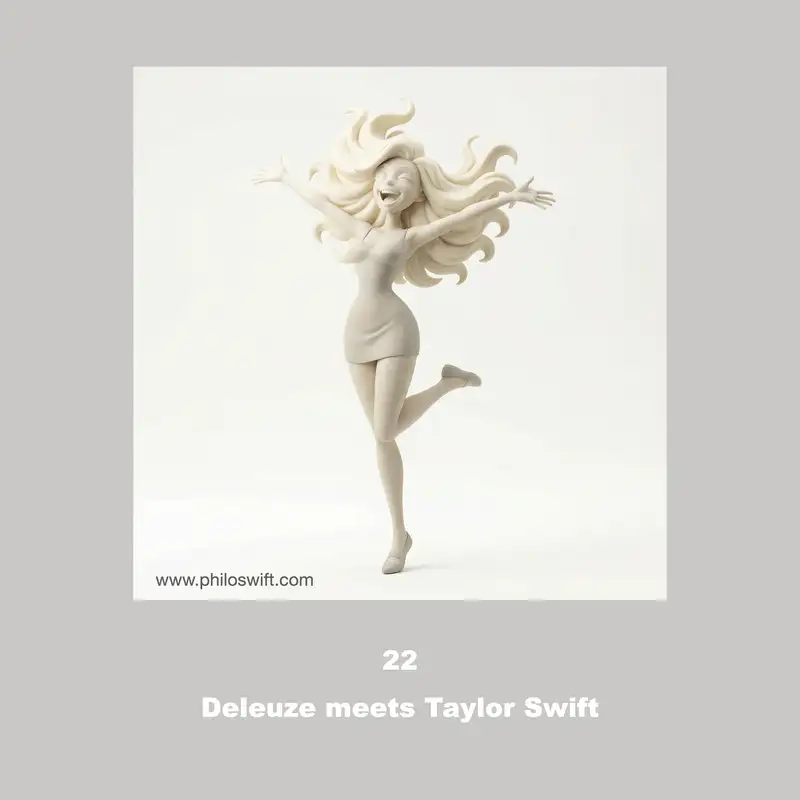
Taylor Swift : 22 (twenty-two) - The Deleuze Easter Egg
Picture this scenario for a second. It is, um, 2:00 in the morning.
The classic hour for an existential crisis.
Exactly right.
Yeah.
You are sitting on the floor of your bedroom, your back is just pressed hard against the bed frame.
Yeah.
And, you know, the only light in the room is bleeding in from a street lamp outside.
Casting those really long, jagged shadows across the walls.
Yeah, exactly that vibe. You have a pair of headphones on.
Yeah.
And playing on an absolute unending loop is a pop song, a massive, stadium-shaking, glitter cannon of a pop song.
And you're crying.
You're crying.
Mm-hmm.
You're feeling the weight of the entire world, um, the crushing confusion of your own identity, the sting of a really highly specific memory, and it's all perfectly distilled into a three-and-a-half-minute track about a breakup.
Or just about being young or, you know, not knowing who you are anymore.
Right. And in that specific moment, you feel like that song is literally the only thing in the universe that actually understands the chaos inside your own head.
It's a very visceral, emotional image.
Yeah, totally. So I want you to hold onto that feeling, because now I want you to mentally transport yourself somewhere, uh, completely different.
Oh, boy, where are we going?
You are in a heavy, smoke-filled, centuries-old hall of a Parisian university.
A very different aesthetic.
Very. The air smells like old paper, pipe tobacco, and honestly, intense intellectual intimidation.
Right, the kind of place where you whisper, even if no one is studying.
Exactly. And there are these academics in tweed jackets arguing fiercely about the fundamental nature of existence.
They're debating ontology, metaphysics, the rigid structures of human subjectivity.
Yeah, it is the absolute peak of 20th-century French philosophy.
So we have these two entirely different worlds. On one hand, you have the late-night tear-stained confessions of teenage pop music.
And on the other, the hyper-intellectual intimidating halls of academic philosophy.
Which, by all conventional logic, have absolutely nothing to do with each other. I mean, they shouldn't even occupy the same sentence, let alone the same analysis.
But on this deep dive, we are basically gonna smash those two worlds together at high speed.
I love that.
Yeah, we are exploring this really fascinating rule-breaking book excerpt. It's from a broader project called the Viphilo Swift Collection.
And the author of this collection is completely anonymous, right?
Yeah, they write under the pseudonym ̄R·Sui, which translates from Taiwanese Mandarin to, um, mouse-colored cat.
Mouse-colored cat. It's such an evocative pen name.
It really is. And our specific focus today is an essay titled simply, "22 ́Deleuze Meets Taylor Swift."
Wow.
Yeah. We are talking about the hit song from The Red Era, paired with Gilles Deleuze, who is arguably one of the most complex, revolutionary, and challenging French philosophers of the 20th century.
I mean, on the surface, it sounds like an internet meme. It sounds like a cynical gimmick designed just to get clicks.
Right, like clickbait for academics.
Exactly. But the text itself establishes right from the beginning that this is a very serious, profound experiment in thought.
Yeah, and the resulting collision forces us to look at both of those worlds, and, more importantly, to look at ourselves in a radically different way.
It really does.
So I wanna speak directly to you, the listener, for a second. Have you ever felt like you are, um, multiple contradictory people all at the exact same time?
I think we all have at some point.
For sure.
Mm-hmm.
Have you ever felt like your identity isn't just one straight line, but this chaotic mess of different moods and desires?
Or even on a more cultural level, right? Have you ever felt judged for treating a so-called guilty pleasure pop song with the exact same reverence and emotional depth as you would a classic novel?
Or a critically acclaimed independent film? Like, if you've ever hidden your playlist when a coworker walked by...
Guilty as charged.
then this deep dive is gonna completely validate those feelings.
Yeah.
It fundamentally changes how we look at the concept of maturity, how we view our own identity, and strangely enough, how we view the terrifying rise of artificial intelligence.
We should probably set the stage properly regarding the scope of this analysis, though.
Point.
Because the author's note makes something abundantly clear, this discussion will not explain Taylor Swift to you, nor will it provide, like, a comprehensive textbook breakdown of Gilles Deleuze's entire philosophical system.
Right, if someone is looking for a pop star biography or a really dense academic primer, they are definitely in the wrong place.
The author explicitly writes, "No one here explains Taylor Swift. No one here explains the philosopher."
So the immediate question is, what exactly are we doing if we aren't explaining them?
The author frames the goal brilliantly. They say the objective is simply to seat them at the same table and wait to see who spills first.
Oh, I love that phrasing. It is the creation of a dialogue.
Exactly. It's a space where a piece of mass culture music and a dense philosophical tradition are forced to look each other in the eye.
Let's pull up some chairs to that table, then, but, um, before we introduce Deleuze or analyze the lyrics of "22," we have to address the elephant in the room.
The
Yes, the pretension that usually surrounds this kind of topic. The author notes in the preface that pairing a stadium pop star with a legendary philosopher makes serious people deeply uncomfortable.
It makes them smirk.
Right. Why do we have that instinctual, slightly condescending reaction when we hear the title of this essay?
Well, that smirk is not a natural biological reaction. It is a learned social behavior.
Okay, let's unpack this. What do you mean by "learned social behavior?"
To explain the mechanics of that smirk, the author brings in the sociologist Pierre Bourdieu, specifically referencing his monumental 1979 work, Distinction.
Oh, Distinction, that's a heavy hitter.
It is. Bourdieu spent his entire career analyzing how society uses culture to maintain power dynamics.
Let's dig into that, because it seems completely crucial for dismantling the barrier between these two worlds. What is the actual mechanism of that social sorting?
So Bourdieu's core argument is that our tastes, what we consider good art versus bad art, or high culture versus low culture, are almost never based on an objective measure of intellectual depth.
Or inherent aesthetic value, right?
Right, exactly. We like to think that a classical symphony is mathematically and inherently more profound than a pop song.But Bourdieu argues that taste is actually a mechanism for social sorting.
Like a way of categorizing ourselves.
Yes, and crucially, a way to separate ourselves from other people.
So deciding that a dense philosophical text deserves deep, quiet contemplation, while a top 40 radio hit is relegated to mere entertainment, that isn't about the actual content of those two things.
Not at all.
It's about maintaining a hierarchy.
Exactly right. High culture isn't automatically profound and low culture isn't automatically shallow, but society circulates them differently.
The text captures this perfectly actually. It says, "One circulates with credentials, the other circulates with playlists."
That's the perfect summary. To engage with high culture, you usually need a credential.
Like, you need a university degree to be taken seriously when discussing Hegel.
Right, or you need a background in art history to properly appreciate abstract expressionism. High culture functions as a status signal precisely because the barrier to entry is so high.
It proves you have the education, the background, and the social capital to understand it.
Exactly.
Wait, so if the value of high culture is the barrier to entry, then pop culture is treated as suspect purely because it lacks that barrier.
Bingo. It has zero barrier to entry.
If a song is beloved by millions of people across every demographic, it can no longer function as a status signal to elevate the elite. Like, you can't feel special if everyone else gets it too.
That is the exact mechanism. When people smirk at the idea of Deleuze Meets Taylor Swift, they're not offering a thoughtful critique of the song's lyrical complexity.
They're defending their turf.
Yes.
They're defending their social territory. They're essentially saying, "Philosophy is my hard-earned credential-"
Yeah.
you cannot apply my credential to something that millions of teenagers are screaming in a stadium."
"That devalues the currency of my education."
Precisely. The resistance is territorial, not intellectual.
And the author makes it clear they aren't trying to argue that Taylor Swift is literally a philosopher sitting at a desk writing treatises. No, trying to do that would be, as the author says, "Tedious and false in the wrong way."
Instead, the proposition is much more unsettling to those cultural gatekeepers.
The proposition is that the questions raised in her music inquiries into identity, memory, power, love, and freedom are the exact same questions that preoccupied Rousseau, Arendt, Nietzsche, and Wittgenstein.
That is wild to think about, the figures who dominate university syllabi were agonizing over the exact same human experiences that are compressed into a three and a half minute track.
There is a line in the text I love, "The difference is not depth, but permission."
Oh, wow. That is a massive paradigm shift. A philosopher is permitted by society to ask these questions because they do it in a heavy book published by an academic press.
But a pop star just asks them in front of 70,000 people without waiting for institutional permission.
And this concept of permission leads directly into one of the most compelling framing devices in the source material, which is the apocryphal forward.
Yes, the imagined forward written from the perspective of Taylor.
It is explicitly a literary invention written at 2:00 AM attempting to bridge the gap between the stadium and the study.
This imagined Taylor talks about spending her life scribbling secrets in spiral notebooks, trying to understand why time passes differently when you're in love.
And why it seems to stop entirely when your heart is broken.
Right, and if a philosopher asks why time dilates during heartbreak, we call it the phenomenology of time. We give it a dense academic label and study it.
But when a young woman asks those exact same questions in a song, it gets completely dismissed. The imagined Taylor says, "For years, I was told that my feelings were too much, too loud, too frequent, too feminine."
Which reveals another whole layer of social sorting. It's not just about formal education, it's heavily gendered.
It really is. It's the societal dismissal of intense emotion, specifically the adolescent female experience.
Society tends to treat the writing of breakup songs as if adolescence isn't a time of profound, almost violent, philosophical questioning.
The author observes that people act as if adolescence wasn't the time when you feel the world with the violence of a summer storm.
I think anyone listening can relate to that. When you are a teenager, you are essentially a walking existential crisis.
You really are. You are constantly asking, "Who am I? What is my place in the universe? Why does suffering exist? What is the nature of true connection?"
These are the foundational questions of the human condition.
But because they are wrapped up in a melody and delivered with extreme emotional intensity, society slaps a label on it. They call it playing the victim or being overly dramatic.
The synthesis provided by the author here is really striking. By connecting those 2:00 AM anxieties to the history of philosophy, the text validates that raw emotion.
The imagined Taylor suspects that behind the spectacle of the stadiums, everyone is actually asking the same terrifying questions that keep people awake after midnight.
Questions such as, "Why does the memory of a scarf left in a drawer weigh more heavily than an entire decade?"
That specific imagery, a scarf left in a drawer, is so potent. It points to a really strange truth about human experience.
How so?
Well, you can have 10 years of relatively pleasant, forgettable routine and then one tiny hyper-specific object holds the emotional weight of a collapsing star. Like why does that happen?
Philosophically, that is an inquiry into the nature of memory, materiality, and meaning.
It asks whether we are defined by those who love us or by those who leave us.
Which is a fundamental question of existential authenticity. The author notes that realizing these sleepless nights mirror the anxieties of Kierkegaard or Nietzsche is both strange and strangely comforting.
The text says, "It's as if the ghosts that haunt our hallways actually have university degrees."
I love that line.
Me too. The idea that when you are alone in your room crying over a lyric, you aren't just being a dramatic teenager. You are unwittingly participating in a debate that has raged for thousands of years.
You are arguing with Sartre about how the gaze of other people traps you. You are debating Plato about the nature of illusion.
The intensity of feeling isn't a failure of rationality. It is the very engine of philosophical inquiry. Your tears are ink and your doubts are philosophy.
So having dismantled the artificial barrier between high and low culture, and having established that the pop song and the philosophical treatise carry the same human baggage, we really need to meet the philosophical counterpart for this specific deep dive.
Yes, we need to introduce the thinker sitting across the table from the song 22. Enter Gilles Deleuze.
Born in Paris in 1925, grew up in the 17th arrondissement, and then proceeded to completely rewire how human beings think about reality.
The biography in our source text is brief, but it paints a picture of a mind that was entirely singular, and sadly, a life that ended tragically.
Yeah. In 1995, severely ill and struggling to breathe due to respiratory disease, he took his own life by throwing himself from his Paris apartment window.
The text refers to this tragic end as the ultimate line of flight.
It is a devastating conclusion to a life that was fundamentally defined by vitalism.
Vitalism, meaning a philosophical focus on life, movement, and the forces of creation over static, dead categories, right?
Exactly. And to understand why Deleuze is the perfect intellectual pairing for a pop song, we have to examine his methodology.
Right. Because traditional Western philosophy was largely about building massive, rigid systems to classify the world.
Think of Kant or Hegel constructing these immense intellectual cathedrals where every concept has a permanent fixed place.
But Deleuze had zero interest in classifying the world. He wanted to connect it.
The text points out that Deleuze didn't seek some abstract, eternal truth. He sought what moves.
I am so fascinated by how he treated the philosophers who came before him. Like he read Nietzsches, Spinoza and Bergson, but he didn't treat their work as sacred monuments to be worshiped from afar.
No, he treated their theories as toolboxes.
A toolbox. It is such a vital distinction. You don't worship a hammer. You pick it up and use it to build something else.
Exactly. Deleuze would take a concept from Spinoza, yank it entirely out of its original 17th century context, rewire it, and force it to work in a completely different modern way.
The author actually calls him the philosopher of remix before the word existed.
And there is the structural parallel to pop music.
Right. The author writes that Deleuze thinks of philosophy the way Taylor approaches music. You take what exists, you deterritorialize it, you turn it into something else.
Pop music is completely built on sampling. Taking a chord progression from the '50s, a drum beat from the '80s, a vocal cadence from hip-hop, and remaking it into something new.
And Deleuze was doing exactly that, but with intellectual concepts instead of audio files.
So to truly grasp Deleuze's relevance to the song 22, we have to tackle his most famous and perhaps most difficult concept.
Okay, brace yourselves.
It originates from a book he co-authored with a psychoanalyst, Felix Cuitard, called A Thousand Plateaus. The concept is the rhizome.
The rhizome. This is the absolute core of the text's argument. If we understand the rhizome, the rest of the puzzle falls into place. But, you know, philosophical definitions can get muddy quickly.
They really can.
Let's start with what a rhizome is not.
Good approach. For thousands of years, Western thought has been dominated by what Deleuze called an arborescent model. Arborescent simply means tree-like.
When you say tree-like, we see that everywhere in society. Family trees, evolutionary trees, corporate organizational charts.
Exactly. Consider the physical structure of a tree. It has a single deep central root, a definitive point of origin.
Okay.
From that root grows a solid central trunk. From that trunk, branches split off in a strict hierarchy. A tree implies a single source of truth, a stable core, and a top-down organization.
And Deleuze argued that our traditional view of human identity is essentially a tree.
Yes. We are taught that we have a core self, a central, unchanging personality, and all our actions, moods, and thoughts are just branches growing out of that one true identity.
So, the language of the tree is, "I am." Like, "I am this specific kind of person."
Precisely. Now, contrast that arborescent structure with the rhizome. In botany, a rhizome is a continuously growing horizontal underground stem that puts out lateral shoots and adventitious roots at random intervals.
Think of ginger root, crab grass, or a bamboo forest.
Right. It spreads out everywhere, horizontally, without a clear pattern.
It has no center. It has no single point of origin.
It possesses no top and no bottom. Any point of a rhizome can be connected to any other point, and in fact, it must be.
If you physically break a rhizome at a certain spot, it doesn't die. It simply starts growing again along a new line. It is a network of multiplicities.
I want to translate this into a modern context, because it's so important. If traditional identity is a tree, like a single neatly organized document saved on your computer desktop
Deleuze is arguing that this is a complete fiction.
Right. Your identity is actually a rhizome. It is like having 50 browser tabs open on your screen at the exact same time.
I love this analogy. One tab is playing a melancholic acoustic song. Another tab is an article you're researching for your career.
Another tab is a group chat where you are gossiping with friends. Another tab is a recipe for dinner.
And traditional psychology says you have to figure out which tab is the real you and close the others.
But Deleuze says none of those tabs is the exclusive real you, while the others are fake. They are all you.
You are the simultaneous execution of all those tabs in a decentralized network.
You are the entirety of the open browser, not any single tab. Deleuze and Guattari argued that a fixed, static identity simply does not exist.
We should fundamentally stop using the verb "to be" and replace it with the verb "to become."
Yes. We no longer state, "I am," but rather, "I become." A human being is not a solid coherent block of marble carved into a single shape.
A human being is, as the text so brilliantly phrases it, an inner rave.
An inner rave. Contradictory moods, intensities, bursts, lines of flight.
Which brings us directly back to the lyrics of the song 22. What is the central defining emotional statement of that specific track?
The chorus hinges on the line, "We're happy, free, confused, and lonely at the same time."
Now, a traditional arborescent psychologist would look at that statement, claiming to be happy and lonely at the exact same moment, and say, "That is cognitive dissonance."
"That is a contradiction. This person is confused, immature, and they need to resolve these conflicting emotions into a single stable state."
They would literally tell you to figure out which one you actually are. Pick a lane.
But Deleuze would look at that exact same lyric and say, "No, that is not a contradiction, and it is certainly not a psychological problem to be solved. That is an arrangement."
That lyric is a perfect articulate description of a rhizome in action.
It is multiple, intersecting lines of feeling that co-exist without ever needing to cancel each other out.
Being everything at once is not a failure of maturity. It is the normal, healthy condition of a vital interesting life.
The source text includes a concise summary section that frames this beautifully. It notes that Deleuze never asks, "Who am I?" But rather, "What can I become?"
And it declares that the world belongs to people who don't fit in.
Because if you spend your energy trying to fit in, you are actively trying to force your wild spreading rhizome into the rigid shape of a tree.
You are pruning your own identity to death, just to make society comfortable.
It is a profound philosophical shift. Instead of viewing your internal chaos and conflicting emotions as a failure to achieve maturity, you begin to view that multiplicity as a highly productive state of being.
The theory of the inner rave is fascinating, but what does a rhizomatic person actually look like in practice? If we only talk about browser tabs and underground roots, it remains kind of abstract.
Right, we need to ground it.
So the text transitions from the definition of the rhizome into a highly specific practical scenario. It uses a theoretical dinner conversation to dramatize this exact tension.
The dinner conversation segment is a perfect vehicle for this. It pits two archetypes against each other.
The snob and the Swifty.
Exactly. The snob, who represents traditional, hierarchical, arborescent thinking, and the Swifty, who represents the Deleuzian, rhizomatic perspective.
The snob opens the argument exactly as one might expect. They declare, "'22 is an ode to immaturity. Being happy, free, confused, and lonely at the same time is a diagnosis, not a philosophy."
Notice the language the snob uses. "Diagnosis."
They're using the language of pathology.
Yes. They view the multiplicity of youth as a disease, an error in the system that needs to be cured by growing up.
But the Swifty counters this immediately. They say, "Deleuze spent his career demonstrating that fixed identity is a prison. Being many things at once is not confusion, it's a rhizome. Taylor isn't describing a problem; she's describing the only honest way to exist at 22."
The Swifty vigorously defends the integrity of the arrangement. The snob, however, pivots to attack a specific, seemingly trivial detail from the song's lyrics.
The snob says, "'A rhizome.' You invoke a thousand plateaus to justify breakfast at midnight? That's ridiculous."
Breakfast at midnight, it is such a throwaway line in the context of a pop song.
It evokes an image of kids staying up late, going to a diner, and eating pancakes. How does the Swifty defend the philosophical rigor of eating pancakes at midnight?
This specific defense introduces another massive Deleuzian concept, arguably his most famous analytical tool alongside the rhizome, deterritorialization.
I need to stop you because deterritorialization sounds like a word specifically designed to terrify undergraduates.
It does sound intimidating.
What is the actual mechanism of deterritorialization? How does it function?
So, to deterritorialize something is to take an object, a concept, or a practice out of its original context, out of its original territory.
Where it has a fixed, culturally agreed-upon meaning and function.
Exactly. You remove it from that territory and place it somewhere entirely new, forcing it to function in a completely different way.
It is essentially an act of conceptual kidnapping and repurposing.
That's a great way to put it.
Give me a concrete example outside of pop music to ground this, because I want to make sure I fully grasped it.
Consider a piece of driftwood.
Okay, driftwood.
In its original territory, a tree growing in a forest, it is deeply embedded in a biological system.
Oh.
It grows, it photosynthesizes, it drops leaves.
Right.
If a storm knocks that tree into a river and a piece of wood washes up on a beach, it has been physically removed from its territory.
But it's still just wood.
Exactly. But deterritorialization happens when an artist walks down that beach, picks up the driftwood, takes it into a sterile white gallery, and mounts it on a pedestal.
Oh, wow.
The artist has deterritorialized the wood. It is no longer functioning as organic matter. It is now functioning as a sculpture.
It has been removed from the territory of nature and forced into the territory of art. Its meaning has been entirely rewritten by its displacement.
That clarifies the mechanism perfectly, doesn't it? So, returning to the dinner conversation, how does the concept of deterritorialization apply to eating breakfast at midnight?
The Swifty in the text explains the mechanism flawlessly. They argue that breakfast at midnight is an act of perfect deterritorialization. Think about the cultural weight of breakfast.
It is a highly regimented, heavily territorialized ritual.
Breakfast belongs exclusively to the morning. It belongs to what we might call the adult calendar.
Its function is to provide energy so you can go to work and be a productive member of capitalist society.
It is bound by chronological time, what the ancient Greeks called Chronos, the marching, linear, oppressive, forward ticking of the clock.
Breakfast is the meal of responsibility and civic duty.
Yes. Therefore, when you take the specific food of responsibility, pancakes, eggs, bacon, and you consume it at midnight, in the middle of a chaotic party, you have violently stripped it of its original function.
You have removed it from the territory of the morning routine.
It is no longer about preparing for the workday. It becomes an act of joyful rebellion against the workday.
As the text notes earlier in a different section, midnight breakfast kills Chronos. It destroys linear time. It turns a mundane, obligatory meal into what Deleuze calls a line-of-flight.
A line-of-flight, that is another crucial term here.
It means a trajectory of escape, a way of slipping out of the rigid, arborescent structures of society.
The snob looks at the act of eating breakfast at midnight and dismisses it as mere nonsense.
But the Swifty points out that Deleuze understood nonsense to be a highly valid, potent, philosophical position. Nonsense disrupts the established order. It breaks the machine.
The text applies this exact same logic to lipstick, actually.
Oh, yes. It says lipstick thinks in networks. It refers to the metaphysics of portable lipstick.
In its normal day-to-day territory, lipstick is just a cosmetic product. It's something you buy at the pharmacy.
But when you put it on at midnight surrounded by friends, getting ready to face the unpredictability of the city, it is deterritorialized.
It transforms. It becomes war paint. It becomes a portable manifesto.
It connects you to a feeling of power, to the music, to the energy of the night. It stops being a product and becomes a node in the network.
It ceases to be an object and becomes an intensity.And effect operating within the arrangement of the party.
But the snob in the dialogue isn't convinced by this defense, and the snob raises a critique that, frankly, many people listening right now might be thinking.
The snob says, "You can't build anything on lines of flight. At some point, you have to grow up."
I wanna push back on the Deleuzian view here, actually, because practically speaking, society requires some level of arborescent structure to function, doesn't it?
It's fine to be 22, eating pancakes at midnight, operating as a chaotic inner-rave, but you can't be 45, eating pancakes at midnight, avoiding all responsibility.
If everyone is a pure rhizome, who builds the roads? Who pays the mortgage?
Don't you eventually have to solidify your identity? Doesn't the rhizome essentially have to die so the responsible adult can live?
It is the defining question of adulthood, driven by exactly what the text calls the metaphysics of civil servants. We are taught that responsibility requires rigidity.
But the Swifty provides the Deleuzian counterargument, and it redefines the entire concept of aging.
The Swifty says, "For Deleuze, growing up doesn't mean settling down, it means connecting better."
But wait, how does connecting better translate to paying a mortgage or building roads? What does it actually mean to mature as a rhizome?
It means that true maturity is not the process of amputating parts of your identity. It is not about cutting off the confused and lonely browser tabs so you can just be a stable, boring block of functional.
Okay, I see.
Maturity, in a Deleuzian sense, is the ability to sustain larger, more complex networks of meaning without collapsing. At 22, you are connected to joy, loneliness, doubt, and the party.
The snob's version of maturity, the civil servant model, is just a rhizome that has been bullied into growing in a straight line.
It is a fundamental impoverishment of human experience. You can build roads and pay mortgages while still maintaining an inner multiplicity. The tragedy is that we assume we must kill the multiplicity to do the paperwork.
Your maturity is just a rhizome that has been forced to grow in a straight line. That is a devastating critique of modern adulthood.
So many people believe they're becoming maturer, when in reality, they're just becoming smaller.
They are shutting down their internal tabs until only one work-approved tab is left open.
The snob attempts one final attack in the dialogue. They say, "Still, reducing Deleuze to a party song is intellectually lazy."
And the Swifty delivers the definitive counter-strike. "Deleuze wrote that the concept must be a party of the mind, not a funeral. You're confusing seriousness with sadness, and that's exactly the trap he spent his life dismantling."
We fall into that trap constantly. We inherently assume that if something is funny, joyful, or involves dancing, it cannot possibly possess intellectual rigor.
We think philosophy must look like an old man frowning in a dusty library.
But Deleuze violently rejects that. The text argues that 22 is the most Deleuzian song possible, precisely because it thinks while dancing.
To visually illustrate this concept of thinking while dancing, the author provides a surreal, evocative vignette, titled Taylor and Deleuze in a Taxi.
It's a highly cinematic scenario.
Imagine it, it's Paris, a light rain is falling on the cobblestones, it's a shared Uber. Taylor Swift gets into the backseat, shaking off the rain, and Gilles Deleuze is already sitting there, staring intently out the window at the wet streets.
She notices his intense focus and asks him what he's thinking so hard about. He replies, "I was looking at the connections between the streets. Cities think in networks."
Which is pure Deleuzian theory. A city is the ultimate physical manifestation of a rhizome. It has no single center, and you could take a thousand different intersecting paths to arrive at the exact same destination.
Taylor replies simply, "Songs too."
He then addresses her directly, bringing up her own lyric. "Yours says that you can be happy, free, confused, and alone at the same time."
She tries to brush it off, modestly saying it's just a description of a night out at 22, but Deleuze leans in and insists, "No, it's an arrangement. It's a subject that is being created in real time."
A subject that is being created in real time, that implies that identity isn't a possession you carry around, it's an action you are constantly performing.
Taylor shrugs and says she just calls it a party, and Deleuze delivers this incredible line, "Parties are very effective metaphysical machines."
A metaphysical... Metaphysical machine. Let's break down why a party qualifies as a machine.
Well, a machine takes inputs, processes them, and generates a new output.
When you walk into a party, you do not know who you are going to encounter, what unexpected conversations will alter your perspective, or how the specific arrangement of the music and the crowd will affect your neurochemistry.
You enter the party as one specific arrangement of identity, and through the friction and connection of the night, you leave as a slightly different arrangement.
The party generates new realities, new connections, new ways of being. It is literally a machine for becoming.
Having explored the dinner conversation and the metaphysical taxi ride, the text shifts its methodology again.
It takes these vivid metaphors, the rhizome, the inner rave, the deterritorialized breakfast, and places them under a microscope in a mock academic setting.
It introduces a fictional academic, Professor Malic Merriwell, to formalize the shifting identity and expose what he calls the ontological paradox at the heart of the song.
Let's define ontology quickly so we understand Merriwell's angle. Ontology is the branch of philosophy that studies the nature of being, of existence, of reality itself.
When you ask, what is a human being fundamentally made of, you are asking an ontological question.
Professor Merriwell argues that Western philosophy has spent centuries trying to resolve the messy contradictions of human emotion by stabilizing identity.
We constantly try to fix people into permanent categories, roles, or coherent narratives. Society demands to know, are you a mother, an engineer, a stoic, a victim, a success?
We are obsessed with putting a pin in the butterfly so we can study it under glass.
Yeah.
We demand that human beings hold still.
But Merriwell argues that the emotional turbulence described in 22 suggests the exact opposite hypothesis. Identity never really stabilizes. It circulates.
It circulates, much like blood in a body or electricity in a circuit.
Merriwell posits that through the lens of Deleuze, this constant circulation is what creates an arrangement. He defines it as a temporary configuration of effects, relationships, and intensities that produces a subject without ever freezing it.
Without ever freezing it. There's a profound terror, but also a massive sense of liberation in that idea.
It means you are never finished. You are never finally, permanently, and inescapably you.
The text illustrates this debate about how we view youth and identity through a satirical multiple-choice quiz titled, Who Wants to Win Nothing?
Let's adapt that quiz into a conversation about the prevailing theories of youth, because Professor Merriwell systematically dismantles the way as adults try to explain away 20-somethings.
The core question Merriwell poses is how we should philosophically interpret the chaotic multiplicity of youth.
The first prevailing theory, let's call it the continuity theory, argues that human identity is inherently stable and just gradually becomes clearer with age.
This is the classic parental reassurance: You're just confused right now. You'll figure out who you really are when you're older.
Merriwell completely dismisses this as a reassuring but metaphysically naive proposition.
Why is it naive?
Because it relies on the false assumption of a core self that remains untouched by the real turbulence of life.
It assumes that aging is just a process of closing browser tabs until you are left with one perfectly clear, serene tab.
It is a comforting fiction we invent to protect ourselves from the vertigo of constant unpredictable change.
The second theory Merriwell attacks is the idea that youth is simply a phase of cognitive error, which was essentially the snob's argument at the dinner party.
Yes. Merriwell identifies this as a psychologizing reduction that confuses existential intensity with a dysfunction of rationality.
That is a dense sentence, but when you unpack it, it's infuriatingly common. It means society looks at the profound, intense, world-shattering feelings of being young and shrinks them down to a biological glitch.
Adults look at a teenager crying over a song and say, oh, their prefrontal cortex just isn't fully developed yet. It's a chemical error.
By labeling it a dysfunction, society completely strips the dignity and the legitimate philosophical weight away from the young person's experience.
It is incredibly patronizing. It provides a convenient excuse for adults to ignore the terrifying massive questions young people are asking.
If the young person is just broken or undeveloped, you don't have to engage with their existential dread. You just have to wait for them to assimilate.
Which brings us to the third theory adults use to control multiplicity: the demand that emotions must be hierarchized to produce a coherent identity.
Merriwell's critique of this is sharp. He calls it a vestige of a disciplinary metaphysics that seeks to organize life like an Excel spreadsheet.
An Excel spreadsheet. That analogy cuts so deep because it is exactly how we try to operate. We attempt to quantify and categorize our own souls.
We try to put our sadness in cell A1, our professional ambition in cell B2, and our romantic desires in cell C3, and then we try to sum it all up at the bottom to get a net value of who we are.
We discipline our own hearts. We tell ourselves, I shouldn't be feeling this groove because objectively, according to my spreadsheet, my life is successful.
We apply middle management logic to our inner lives.
And Deleuze would argue that applying spreadsheet logic to a rhizome is an act of violence against the self. You cannot hierarchize network.
The only valid philosophical conclusion, according to Merriwell and Deleuze, is that identity is a shifting multiplicity of becoming. The subject does not possess a static essence, but rather participates in a network of permanent transformations.
To bring all this academic theory crashing back down to reality, the text introduces a quote from another fictional commentator, Gaston Blunder.
Blunder summarizes Merriwell's dense ontological jargon by invoking the legendary American comedian George Carlin.
Blunder says that Merriwell used four pages of academic jargon to explain that identity stops playing statues and becomes electrical wiring.
At 22, you are happy, lost, in love, and a little stupid all at the same time.Adults dismiss it as immaturity. Philosophers dignify it as an arrangement. And then he paraphrases Carlin.
The Carlin paraphrase is a devastating observation about the human life cycle. It observes that people spend their entire youth desperately trying to figure out who they are, and then they spend their maturity desperately trying to become someone a little interesting again.
We spend our 20s panicked because we don't feel like a solid tree. We violently prune our rhizome to fit into the Excel spreadsheet of the adult world.
We secure the career, the mortgage, the stable, predictable persona.
And then, at 45, we look at our rigid, perfectly straight arborescent life, and we realize we are bored out of our minds.
We realize we successfully murdered the inner rave.
And we spend the rest of our lives an embarrassing amount of money trying to buy back a little bit of that chaotic 22-year-old multiplicity.
We buy the sports car. We blow up our lives. We force a massive line of flight because we finally understand that the Excel spreadsheet was always a prison.
The ultimate argument here is not a Peter Pan syndrome though. The text isn't telling you to act like a reckless 22-year-old forever.
No, it is a philosophical plea not to kill the multiplicity inside of you simply because society told you a clean desktop is more respectable than a messy one. Keep the tabs open. Allow the identity to circulate.
Now, if this analysis ended right here, it would already be a remarkable exploration of pop culture, French philosophy, and the mechanics of human identity.
But this is the moment where the text executes a massive conceptual pivot.
In the afterword, the anonymous author, Mouse-Colored Cat, zooms out from the metaphysics of the individual and attacks the metaphysics of our current technological reality.
If our identity is this messy, beautiful, inner rave, what happens when we introduce a technology fundamentally designed to eliminate messiness and predict our exact next move?
The afterword abruptly shifts the context of everything we've discussed. It moves from Taylor Swift and Deleuze to the terrifying rise of artificial intelligence.
The section is provocatively titled Antidote to Algorithmic Inbreeding, and the author begins with a startling confession.
They freely and openly admit they utilized large language models AI to help construct this very book.
But they do not speak of the AI as an intelligent co-author. They describe these models using a highly specific, critical term, "Stochastic parrots of infinity reading everything and understand nothing."
Stochastic parrots. Let's break down the mechanism of how these large language models actually work, because it's vital to understanding the author's warning.
LLMs aren't thinking. They are stochastic, which means their output is governed by complex probabilities and randomness.
And they are parrots, meaning they simply repeat and remix patterns they have ingested without any actual comprehension of the meaning behind the words.
They predict the next most statistically likely token based on their training data. They have ingested the entire written history of the internet, but their understanding of that text is exactly zero.
They are engines of statistical probability, not engines of comprehension. Yet the author does not reject the tool entirely.
They don't advocate for smashing the servers. Instead, they write, "This is not an abdication of authorship. It is the affirmation of a new role, the data sovereign."
The data sovereign. Why do we need a data sovereign?
To explain this, the author traces a brief history of digital reproduction. They note that back in the late 1980s when digital imaging was first emerging, the great utopian promise of the technology was zero generation loss.
To understand the impact of zero generation loss, consider analog media. If you take a physical piece of paper and run it through a Xerox machine, the copy is slightly fuzzier than the original.
If you take that copy and photocopy it again, it degrades further. If you make a copy of a copy of a copy, eventually you are left with an illegible, gray blur.
The signal degrades.
Hmm.
But with digital files, a copy of a JPEG is mathematically identical to the original JPEG. A copy of a copy of a copy remains pristine.
The fidelity is infinite.
For decades, we viewed infinite, perfect digital reproduction as the ultimate technological triumph. But the author identifies a new catastrophic danger emerging from this perfection.
They state, "Today the danger is not degradation of signal, but degradation of meaning. The more we generate, the less we create."
Degradation of meaning, because if an AI can generate a million grammatically pristine essays on any topic in a fraction of a second, the inherent value of an essay drops to zero.
But the crisis goes deeper than mere economic oversupply. The author introduces a concept that should genuinely terrify us, digital autophagy.
Autophagy is a biological term, correct? It literally translates to self-eating.
Yes. In biology, autophagy is what happens when a body is starving and begins to consume its own cellular tissues to survive.
And the author applies this biological horror to the ecosystem of artificial intelligence. They write, "AI now feeds increasingly on its own outputs, forming recursive loops in which thought becomes smoother, safer, and more average with each iteration."
Let's track the mechanics of this loop. We are currently flooding the internet with millions of articles, images, and posts generated by AI.
When the next generation of AI models is trained, what data are they scraping? They're scraping the internet, which means the AI is now training on text that was written by AI.
It is eating its own output. And when a statistical probability engine feeds on its own statistical probabilities, what is the result?
The text warns us, "By copying itself endlessly, the machine produces not intelligence but conformity."
Because the LLM works by predicting the most average likely sequence of words, it inherently sands off all the rough edges of human thought.
It removes all the weirdness, all the friction, all the unexpected leaps of logic. It generates text that is perfectly structured and completely devoid of a soul.
It is the death of the rhizome on a planetary scale. It replaces the wild, unpredictable forest with a giant, perfectly smooth, featureless, arborescent tree.
A future where all human expression is just a perfectly safe, statistically averaged loop. It is a really bleak vision.
But the author doesn't leave us stranded in that despair. They offer a resistance strategy, a way to fight back against the creeping conformity of the algorithm.
They call this strategy capacitivism.
Capacitivism. The author outlines the methodology. "We do not reject the digital photocopy. We overload it."
But wait, how do you practically overload a machine that has infinite processing power? If the AI has read everything ever written, how do you fight it?
You fight it by doing exactly what the PhiloSwift collection does. The author says, "This series is a deliberate disruption. We inject friction into the circuit."
Remember how we established that AI relies on statistical probability to predict the next logical word?
Because it relies on probability, it is fundamentally incapable of making a true irrational conceptual leap.
As the author states, "AI can organize, it cannot dare."
The author writes, "The conceptual leap, the act of intellectual vandalism, is uniquely human."
Intellectual vandalism, that is an incredible phrase. It means deliberately bashing two completely unrelated, statistically improbable things together just to see what kind of sparks fly.
That is the beating heart of capacitivism. You must introduce sparks that the probabilistic system cannot anticipate.
The AI's training data is vast, but it is strictly bound by what has already happened and what makes logical sense. The author points out, "There is no training data for Wittgenstein in a slammed door, or Deleuze in lipstick."
"An algorithm operating on averages would never logically connect a complex 20th century poststructuralist philosopher with a cosmetic item worn at a stadium pop concert. It violates the math."
By making these bizarre, uniquely human rhizomatic connections, we execute a line of flight. We force the machine onto side roads.
We break the recursive loop of conformity. By being unpredictable, we assume the role of the data sovereign.
The author concludes this section with a powerful mandate for the future. "The citizen of tomorrow will not be the one who passively consumes the flow, but the one who bends it. Sovereignty no longer lies in owning information, but in disturbing its logic."
Disturbing the logic, this brings the entire deep dive full circle.
The reason the song 22 and the philosophy of Gilles Deleuze belong together at the same table isn't just because it's a fun, quirky, intellectual exercise.
It is because the very act of pairing them together is an act of human resistance against a technological infrastructure that desperately wants us to be predictable.
The machine wants us to be a tree.
Yeah.
He wants to know exactly what we will buy, exactly what we will click, and exactly what we will think so it can monetize our attention.
To survive the age of artificial intelligence, we must be an inner rave. We must maintain our chaotic multiplicity.
We have to eat breakfast at midnight just to confuse the algorithm.
We have to actively maintain our multiplicity. In the final moments of the text, the mysterious author, mouse-colored cat, addresses their own anonymity and their motivation.
They write, "The cat has taken the color of the mouse. It has entered the machine."
The biographical section at the end of the book provides these tantalizing, almost certainly fabricated clues about the author's identity.
They are rumored to be a former programmer who turned to law, or perhaps a philosopher thinking in silence between Brussels, Antwerp, and Krakow, which the text cheekily dismisses as a geographical misunderstanding.
Regardless of who the author actually is in the physical world, their philosophical stance is crystal clear. The text concludes, "He maintains that AI can organize thought, but only humans can misbehave creatively. He dislikes lukewarm water, predictable arguments, and cats without ambition. The rest is camouflage."
"Only humans can misbehave creatively." That serves as the thesis statement for this entire ambitious project.
The PhiloSwift collection, whether it's pairing Heidegger with All Too Well or Machiavelli with Getaway Car, isn't just a clever form of literary analysis.
It is an act of creative misbehavior.It is a deliberate strategy to force the algorithm to process Deleuze in lipstick.
It serves as a vital reminder that our capacity to feel intensely, to connect wildly disparate ideas, to be contradictory, confused, happy, and lonely all at the same time is not a flaw in our psychological programming.
It is the very evidence that proves we are not programmed at all. Let's take a breath and synthesize the massive amount of ground we have covered today.
We've covered a lot.
We began by taking a sledgehammer to the artificial snobbish wall separating high academic culture from mass pop culture.
By looking through the lens of Pierre Bourdieu, we revealed that the smirk of the elite is nothing more than social sorting, a defense of credentials.
We realized that the visceral tears of a teenager listening to a pop track are written in the exact same philosophical ink as the most complex textbook.
From there, we encountered Gilles Deleuze and systematically discarded the restrictive, arborescent tree model of identity. We embraced the rhizome.
We learned that experiencing multiple contradictory emotions simultaneously is not a psychological crisis to be cured, but an arrangement to be explored. We learned to dignify and celebrate the inner rave.
We sat through a dinner party and learned the mechanics of deterritorialization, how the simple act of eating pancakes at midnight transforms from a meal into a joyful rebellion against linear time.
We took a taxi ride through the Paris rain and realized that parties are not just gatherings, but highly effective metaphysical machines for becoming.
We engaged with Professor Merrywell's ontology, confirming that human identity is a permanent transformation, not a static Excel spreadsheet waiting to be summed up.
And finally, we confronted the modern existential threat of digital autophagy. We analyzed how the mechanics of AI threaten to trap human thought in an endless self-consuming loop of average safe conformity.
Against this threat, we found our defense mechanism in capacitivism, the uniquely human ability to misbehave creatively, to become intellectual vandals, to introduce vital friction into the machine by forcing impossible rhizomatic connections.
We learned that in an age of infinite perfect generation, our highest calling is to become data sovereigns, disturbing the logic of the algorithm. Which brings us to the end of our analysis of the text itself.
But before we close this deep dive, we always wanna leave you with something entirely new to chew on.
If we accept the premise that our true identity is a rhizome, a messy, beautiful, chaotic network of contradictory browser tabs...
And if we accept that this very human friction is our ultimate defense against the perfectly smooth predictive conformity of AI...
We must look at where these predictive models are currently infiltrating our lives. Consider the algorithms driving modern dating apps or the predictive health metrics on our wearable devices.
When an algorithm determines who you are most compatible with based on historical data averages, or when a device predicts your exact energy levels and schedules your day accordingly, it is fundamentally eliminating serendipity.
It is removing the chance encounter with a person who contradicts your taste, but expands your worldview.
It is deleting the spontaneous decision to stay out until 2:00 AM because your watch tells you to optimize your sleep score.
The provocative question we must ask ourselves is this: By allowing algorithms to optimize our romance and our physical vitality, are we willfully allowing the machine to prune our rhizome?
Are we trading the chaotic world-shaking possibilities of the inner rave for the safety of a perfectly predictable, medically optimized, entirely frictionless tree?
Oh, so the next time you find yourself awake at 2:00 AM, maybe you are sitting on the floor, maybe the shadows are long on the wall, and maybe you are feeling the crushing weight of a memory or the chaotic confusion of your own messy contradictory heart...
Do not push it away. Do not try to spreadsheet it into submission.
Recognize it for what it truly is. It is not a glitch in your maturity. It is your inner rave. It is your philosophy in motion.
And in a world increasingly dominated by machines designed to predict and average out your every move, that messy tear-stained confusion might just be the most profoundly human rebellious thing you have left.